Summary
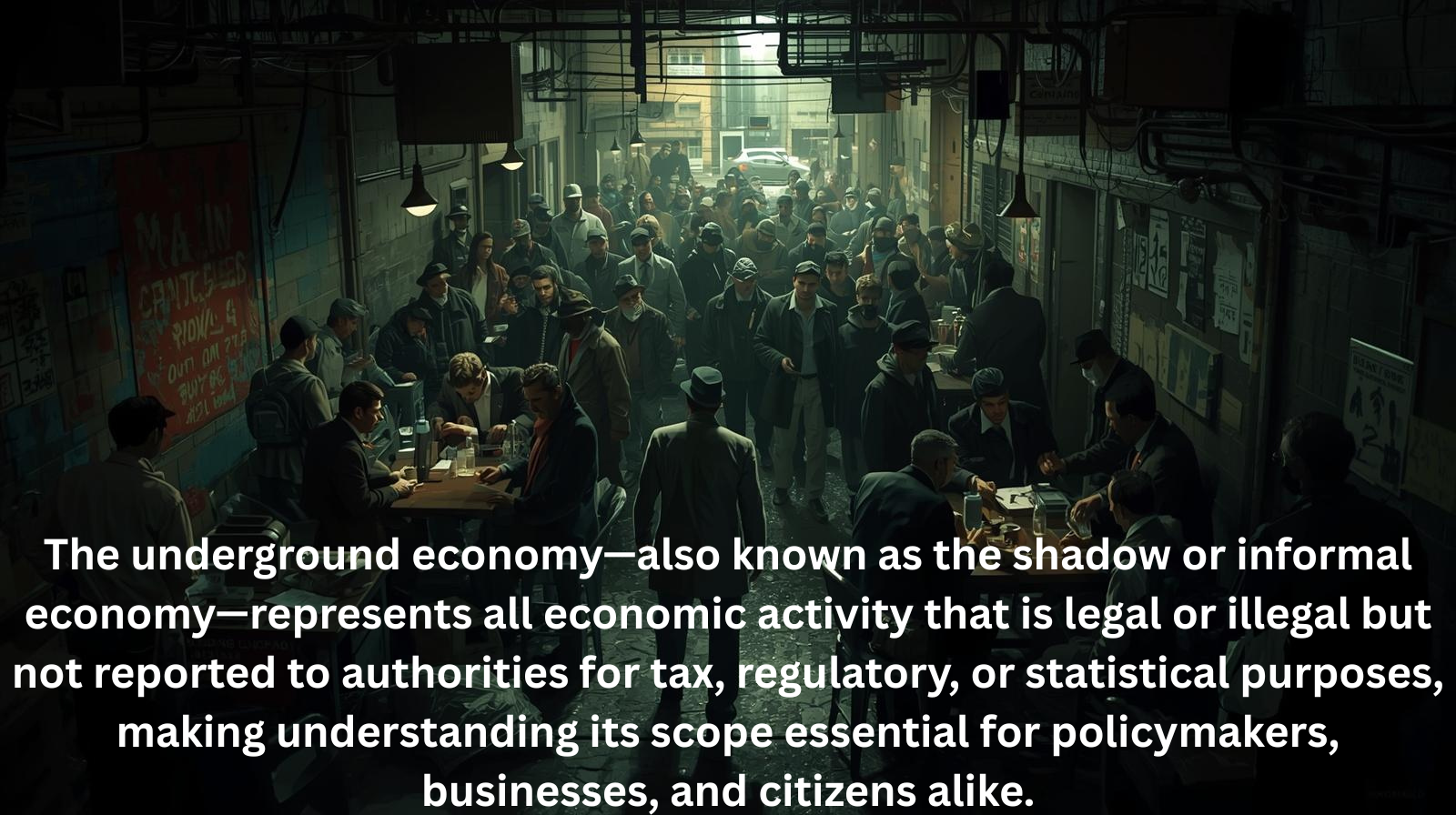
The underground economy—also known as the shadow or informal economy—represents all economic activity that is legal or illegal but not reported to authorities for tax, regulatory, or statistical purposes, making understanding its scope essential for policymakers, businesses, and citizens alike.
Overview
This is a separate and distinct group from those who convert a portion of their income to cash so that purchases are not trackable by any parties, including government agencies. They are still paying income taxes on their income. The group despises the fact that agencies, institutions, and corporations can track their purchases and meddle in their personal life.
Measurement and Scope
How Large Is the U.S. Underground Economy?
Economists estimate the underground economy using indirect methods because participants rarely self-report.
Common approaches include:
- Income-expenditure discrepancies: Comparing reported income to spending patterns.
- Electricity consumption models: Assuming energy use correlates with production.
- Currency demand analysis: High cash usage often signals informal transactions.
Estimates vary, but studies suggest the U.S. shadow economy accounts for 6–12% of GDP, roughly $1.4–$2.8 trillion annually, including unreported babysitting income and organized crime.
National vs. Los Angeles County
Los Angeles County, with its large immigrant population and service-based economy, has one of the highest concentrations of informal work in the U.S.:
- Day laborers, domestic workers, and gig contractors often operate outside formal systems.
-
Researchers estimate 15–20% of economic activity in LA County may be informal, significantly above the national average.
The Tax Gap
The IRS estimates the tax gap—the difference between taxes owed and taxes paid—at $428 billion annually, with unreported income from the underground economy as a major contributor, highlighting the significant fiscal Impact for policymakers.
Industries with High Informality
- Construction and home repair
- Hospitality and food services
- Childcare and eldercare
- Agriculture
- Personal services (hair, nails, fitness training)
Illicit sectors—drug trafficking, human trafficking, counterfeit goods—are harder to measure but add billions more.
Measurement Challenges
Legal but unreported activities (e.g., cash babysitting) are difficult to track without intrusive monitoring. Illicit activities pose even greater challenges due to secrecy and criminal risk. This opacity complicates policymaking and economic forecasting.
Causes and Drivers
Why Do People Participate?
- Tax burdens and regulation: High compliance costs push small businesses to operate informally.
- Lack of formal job opportunities: Immigrants without work authorization often rely on cash jobs.
- Avoiding bureaucracy: Some prefer simplicity over paperwork.
- Financial exclusion: Limited access to banking encourages cash transactions.
Economic Conditions
Unemployment spikes during recessions, expanding the underground economy as people seek survival income. Conversely, strong labor markets shrink informality—but never eliminate it.
Regulatory Complexity
Complex licensing and reporting requirements incentivize businesses to “go off the books.” For example, small contractors may avoid permits to cut costs and speed up projects.
Financial Literacy and Access
Without banking access, individuals rely on cash, which facilitates informality. This is common among low-income households and undocumented immigrants.
Consequences and Impacts
For Workers
- No legal protections or benefits (Social Security, health insurance).
- Vulnerability to exploitation and unsafe conditions.
- Limited upward mobility.
For the Economy
- Distorted GDP and employment statistics.
- Reduced tax revenue, increasing fiscal pressure.
- Unfair competition for compliant businesses.
Social Effects
The underground economy can act as a safety net during downturns, reducing crime by providing income. However, it also enables money laundering and organized crime.
Who Benefits from the Underground Economy?
1. Informal Workers
Survival income for those excluded from formal jobs.
2. Small Businesses
Lower costs by avoiding taxes and compliance.
3. Consumers
Cheaper services and goods.
4. Criminal Enterprises
Profits from illicit trade.
5. Certain Employers
Competitive advantage through under-the-table wages.
6. High-Income Tax Evaders
Use informal channels to hide wealth.
7. Marginalized Communities
Depend on informal work for survival.
Policy and Solutions
Effective Strategies
- Simplify compliance: Reduce licensing and reporting burdens.
- Tax incentives: Encourage formalization through credits and deductions.
- Technology: Use AI and data analytics to detect non-compliance.
- Financial inclusion: Expand access to banking to reduce reliance on cash.
- Trust-building: Improve taxpayer confidence in fair systems.
Balancing Enforcement and Compassion
Policymakers face a dilemma: strict enforcement risks harming vulnerable populations who rely on informal work. Solutions must combine graduated enforcement with pathways to formalization.
Policy-Induced Informality: How Overregulation Fuels the Shadow Economy
Government policies often aim to ensure fairness, safety, and compliance. However, when these policies become excessive—layering laws, regulations, litigation risks, taxation, and punitive measures on nearly every economic activity—they can unintentionally drive people into the underground economy.
Regulatory Overload Creates Barriers
Small businesses and individuals face complex licensing requirements, costly permits, and extensive paperwork. For many, the cost and time required to comply outweigh the benefits of formal participation. This pushes entrepreneurs and service providers toward cash-only, unreported work.
High Tax Burdens and Penalties
Marginal tax rates, payroll taxes, and fear of audits create strong incentives to avoid the formal system. When minor mistakes can lead to severe penalties, informality feels safer and more predictable.
Litigation Risk and Liability
The U.S. legal environment is highly litigious. Formal businesses risk lawsuits over labor, safety, or consumer issues. Operating informally reduces exposure to these risks, even at the cost of legal protections.
Perception of Exploitation
Many Americans view the formal economy as exploitative—burdened by taxes and bureaucracy that favor large corporations and government agencies. The underground economy becomes an alternative, offering autonomy and flexibility.
Alternative to Bureaucracy
For marginalized populations, informal work is often the only viable option. Excessive regulation effectively excludes them from formal participation, creating a dual economy: one highly regulated and costly, the other informal and accessible.
Bottom Line:
Overregulation doesn’t just enforce compliance—it drives non-compliance. When the cost of being “legal” outweighs the benefits, rational actors choose informality. This dynamic explains why the underground economy thrives in sectors like construction, childcare, handymen, dog walking, and personal services.
The underground economy is not a fringe phenomenon—it is woven into America’s economic fabric. While it offers short-term benefits to workers and consumers, its long-term costs include lost revenue, distorted data, and systemic inequality. Addressing it requires nuanced policies that balance enforcement with opportunity, ensuring that the path to formalization is accessible and fair.
Closing Thoughts
The underground economy in the United States is not merely a byproduct of criminal intent—it is often a rational response to an economic system perceived as overly burdensome and intrusive. Excessive regulation, complex tax codes, and punitive enforcement create barriers that push individuals and businesses toward informality as a survival strategy. While the shadow economy offers short-term relief and flexibility, it undermines long-term economic stability, erodes trust in institutions, and perpetuates inequality. Breaking this cycle requires more than enforcement; it demands structural reforms that simplify compliance, reduce unnecessary regulation, and restore fairness to the formal economy. Only then can we close the gap between legality and livelihood and ensure that participation in the formal system is both attainable and beneficial for all.