Introduction
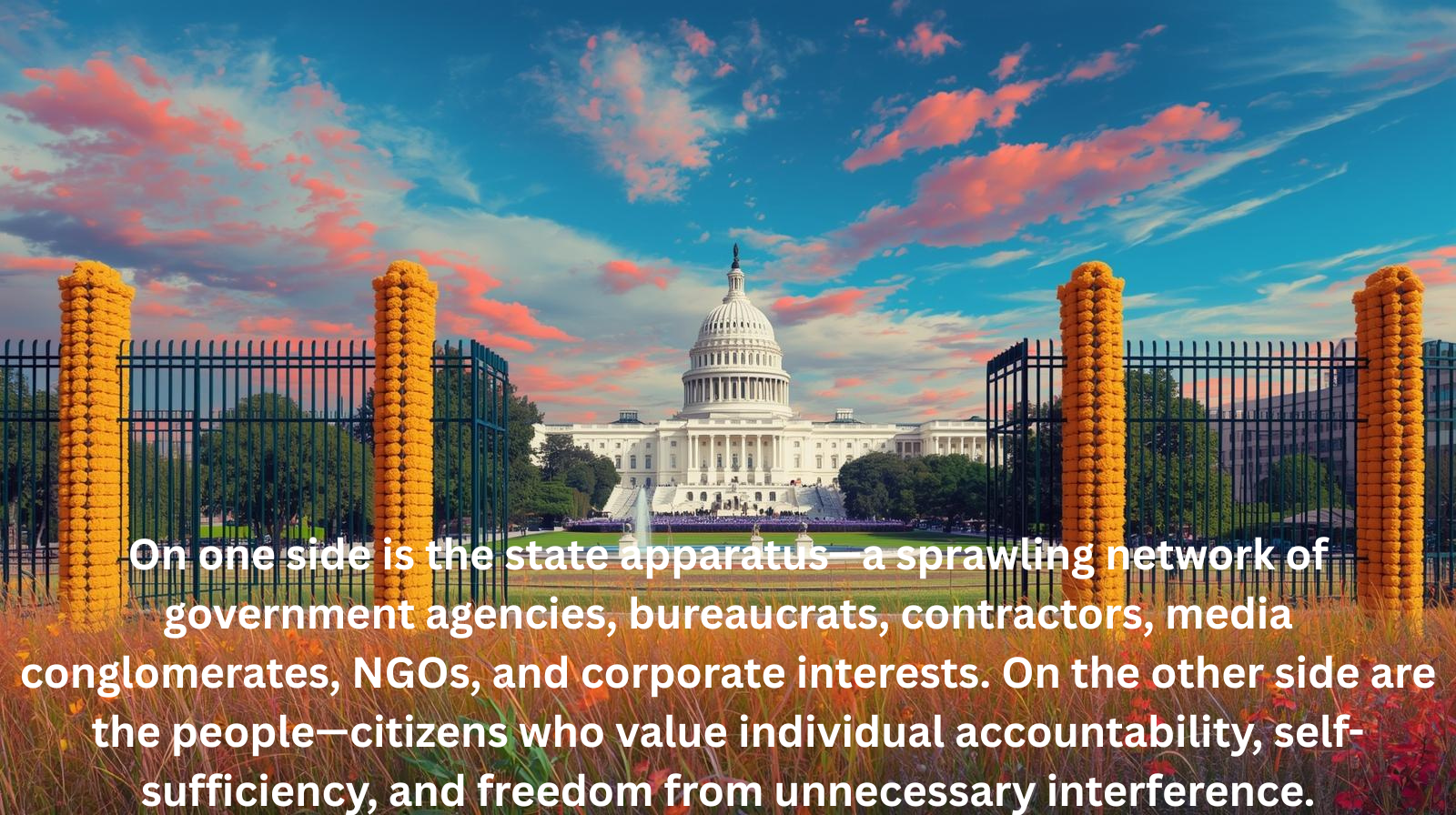
America stands at a crossroads. On one side is the state apparatus—a sprawling network of government agencies, bureaucrats, contractors, media conglomerates, NGOs, and corporate interests. On the other side are the people—citizens who value individual accountability, self-sufficiency, and freedom from unnecessary interference. This is not a mere policy debate; it is a fundamental clash between centralized power and personal liberty.
The State Apparatus: A Leviathan Consuming Liberty
The state apparatus thrives on taxpayer dollars. Productivity and efficiency are irrelevant because its survival depends on consumption, not creation. Every expansion of its size and scope tightens its grip on society.
“I predict future happiness for Americans, if they can prevent the government from wasting the labor of the people under the pretense of taking care of them.”
— Thomas Jefferson
Historical Example:
From three departments in 1789 to hundreds today, the federal bureaucracy employs nearly three million people. Major expansions occurred during FDR’s New Deal and LBJ’s Great Society, embedding the welfare state into American life.
Monopoly Powers and Intrusion
Through unionism, secrecy, and unchecked growth, the state apparatus has acquired monopoly-like powers. It dictates terms through taxation, regulation, and legislative overreach.
“Power is of an encroaching nature, and it ought to be effectually restrained from passing the limits assigned to it.”
— James Madison
Historical Example:
Federal spending exploded from $1 billion in 1900 to over $7 trillion today, consuming nearly 20% of U.S. GDP.
Tactics of Control
The state apparatus does not merely govern; it seeks to dominate—weakening autonomy, engineering cultural disruption, and importing populations with little alignment to American traditions.
“Of all tyrannies, a tyranny sincerely exercised for the good of its victims may be the most oppressive.”
— C.S. Lewis
Historical Example:
The Indian Removal Act of 1830 and forced assimilation policies illustrate early cultural engineering by government power.
The People: The Last Line of Defense
In stark contrast stand the people—those who believe in personal responsibility, hard work, and limited government. They uphold the family unit as the cornerstone of society.
“Liberty must at all hazards be supported. We have a right to it, derived from our Maker.”
— John Adams
The Assault on the Family
Public education systems have become indoctrination centers, undermining parental authority and traditional values.
“The philosophy of the schoolhouse in one generation will be the philosophy of the government in the next.”
— Abraham Lincoln
Modern curricula often prioritize political agendas over critical thinking, leaving families to fight for control over their children’s moral and intellectual development.
The Path Forward
History teaches us that centralized systems eventually collapse under their own weight. The resilience of families and communities committed to liberty will prevail.
“Those who would give up essential liberty, to purchase a little temporary safety, deserve neither liberty nor safety.”
— Benjamin Franklin
Action Steps:
- Strengthen local governance.
- Build community networks independent of state control.
- Demand accountability and transparency.
- Reclaim education and cultural institutions.
Conclusion & Call to Action
The struggle between the state apparatus and the people is not theoretical—it is happening now. The question is whether we will submit to an ever-expanding leviathan or reclaim the principles that made America strong: individual liberty, family integrity, and civic responsibility.
The time for passive hope is over. The time for action is now.
Begin by attending local school board meetings, supporting community-led initiatives, and holding elected officials accountable to inspire direct involvement and tangible resistance. Share this message widely to mobilize others. Organize, educate, and actively oppose the erosion of our freedoms.
If we fail to act now, we risk losing the freedoms and values that previous generations fought to preserve. But if we choose to act, we can ensure that the people’s rights and liberties will prevail for future generations. Remain vigilant!