Summary
If you enjoy a glass of wine, remember that you can do so responsibly, which helps you feel confident and in control of your health choices.
The Plot Twist: Official Guidance Went from “Maybe” to “Make It Smaller”
The biggest clue that the culture has turned the page is federal messaging. The Dietary Guidelines for Americans, 2025–2030 (released 7 January 2026) now states: “Consume no more than one standard drink per day for women and two for men “-a clear, concrete limit to help you drink responsibly. It’s not a dramatic breakup text; it’s more like a gentle, government-issued “maybe don’t make this your nightly hobby.”
And yes—some medical groups weren’t thrilled with how simplified (and nonspecific) the guidance became. The American Association for the Study of Liver Diseases (AASLD) criticized the removal of more precise limits, arguing the public does better with concrete guidance—especially given alcohol’s role in preventable disease. In other words, the guidelines may be “dry,” but the controversy isn’t.
The official vibe is now “sip less,” which means enjoying smaller amounts rather than abstaining completely, helping you balance pleasure with health. It’s about moderation, not abstinence, so you can still savor that glass without guilt.
The “Heart-Healthy” Legend: A Classic Vintage… With Some Sediment
Let’s be honest: a big reason red wine got its halo was the old “French Paradox” storyline and decades of observational studies suggesting moderate drinkers had better cardiovascular outcomes. The problem with observational research is that it can confuse a pattern for a cause. People who enjoy a glass of wine with dinner may also be more likely to have better diets, stronger social connections, or better healthcare access—factors that can make anyone’s stats look rosier.
The American Heart Association now says the important part out loud: no research has proven a direct cause-and-effect link between alcohol and better heart health, and the AHA does not recommend drinking alcohol for health benefits. Translation: the “heart-healthy” story is no longer a bold claim—it’s more of a tasting note with asterisks.
Pun-approved truth: “Wine may have legs, but the evidence doesn’t always stand up.”
Cancer Enters the Chat: When the Party Gets Serious
If heart benefits are now “complicated,” cancer risk messaging is less ambiguous. The World Health Organization (Europe) has stated that, in terms of health harms (especially cancer), there’s no demonstrated “safe level” in the sense of a proven threshold where risk disappears—risk begins with the first drop and rises with consumption. That’s a sobering sentence, but it’s the point.
In the U.S., the Surgeon General’s Advisory on Alcohol and Cancer Risk underscores alcohol as a leading preventable cause of cancer. It describes a causal link to at least seven cancer types, including breast cancer (in women). It also notes evidence that for some cancers, risk may start to rise at around one or fewer drinks per day, which is awkward news for the “one glass is basically a green juice” crowd.
“Wine is romantic. Cancer is not.”
Sleep: The Sneaky Aftertaste Nobody Writes Poems About
Now for the part that doesn’t show up on the menu: sleep. Many people love a nightcap because it feels relaxing, and alcohol can help them fall asleep more quickly. But research suggests alcohol use—especially sustained patterns—can be associated with poorer sleep quality over time, and can disrupt sleep architecture (including REM sleep). So yes, you may drift off faster, but you might also wake up at 3 a.m., wondering why your brain scheduled an emergency meeting.
Longer-term evidence supports the same general theme: alcohol use can predict poorer sleep later, not necessarily the reverse. Translation: if your wine is supposed to be “self-care,” but it’s quietly sabotaging your sleep, it may be pairing badly with your life.
Wine can help you fall asleep—then steal the deep sleep like a polite burglar.
Resveratrol: The Celebrity Ingredient Doing a Cameo, Not a Leading Role
Ah yes, resveratrol—the word that launched a thousand smug dinner-party monologues. Here’s the more grounded 2026 framing: even if certain compounds in red wine are potentially beneficial, major heart-health guidance emphasizes that you don’t need alcohol to get those benefits. Foods like grapes and blueberries contain antioxidants without the risks associated with drinking wine. It’s about choosing healthful options, not relying on alcohol as your supplement.
Meanwhile, public-health agencies emphasize alcohol’s carcinogenic risk and dose-response relationship for cancer, so “but antioxidants!” doesn’t automatically cancel “but risks!” Think of it as nutrition math: resveratrol may add points, but alcohol also adds points—just on the wrong scoreboard.
“If you’re drinking wine for antioxidants, that logic is… grape, but not great.
So Should You Stop? A Reasonable Compromise (No Hair Shirts Required)
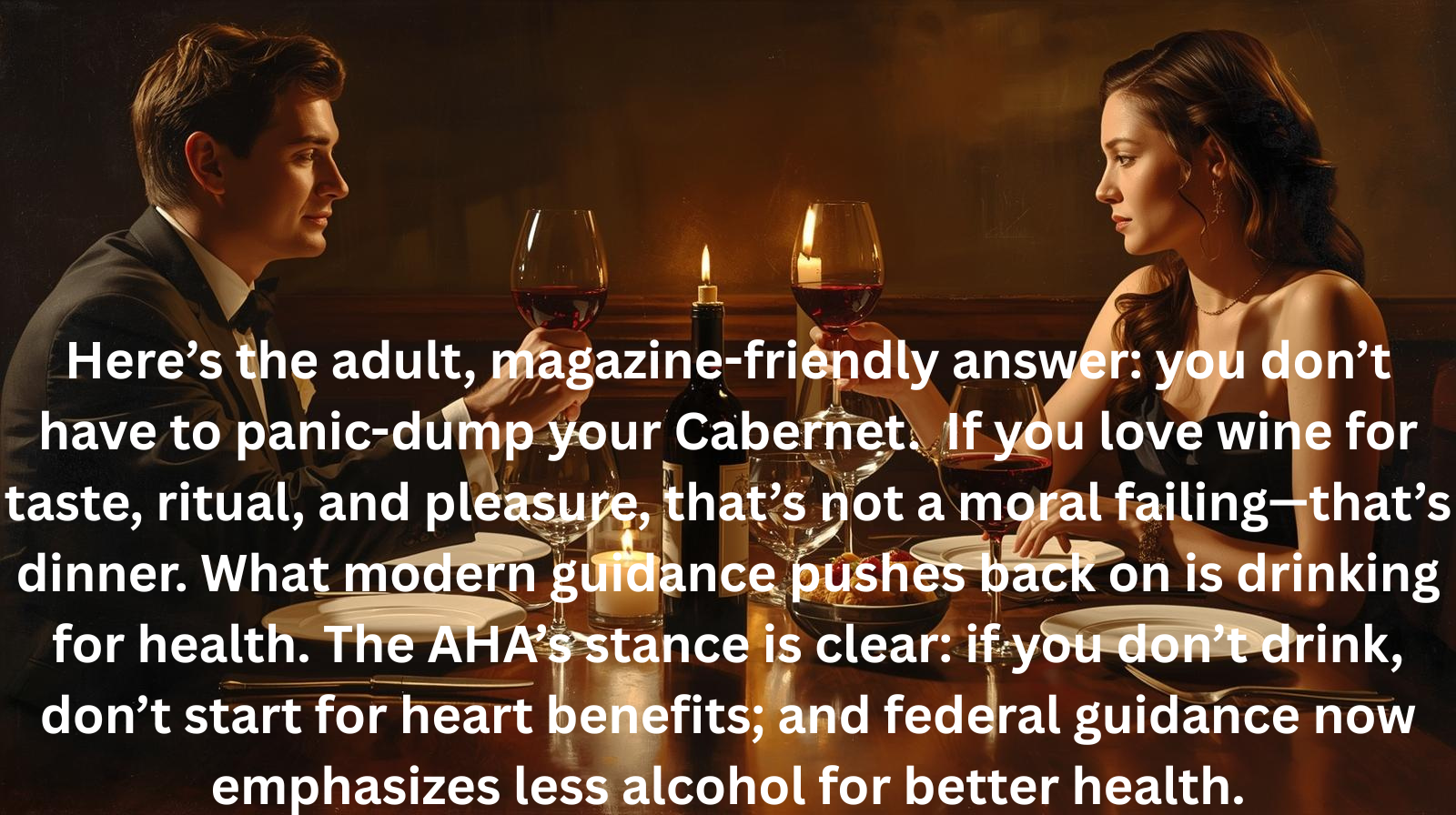
Here’s the adult, magazine-friendly answer: you don’t have to panic-dump your Cabernet. If you love wine for taste, ritual, and pleasure, that’s not a moral failing—that’s dinner. What modern guidance pushes back on is drinking for health. The AHA’s stance is clear: if you don’t drink, don’t start for heart benefits; and federal guidance now emphasizes less alcohol for better health.
Also worth noting: the Dietary Guidelines list groups who should avoid alcohol entirely (e.g., pregnancy, certain conditions/medications, those unable to control intake), and specialty groups like AASLD argue consumers benefit from more transparent, more concrete limits. In other words, for some people, the safest pour is no pour—and that’s not prudish; it’s practical.
Keep the joy—ditch the myth that it’s medicine.
If You Keep the Ritual, Make It Smarter (A Few “Decant the Risk” Moves)
You can reduce risk without turning life into an Excel spreadsheet:
- Measure the pour. A U.S. standard drink is 5 oz of wine (~12% ABV)—many home glasses are… “reserve” sized.
- Make it occasional, not automatic. “Less is better” is the current public-health headline, and habit quietly becomes policy.
- Move it earlier. If sleep matters, remember alcohol is linked to worse sleep quality over time in multiple studies.
- Don’t drink for your heart. The AHA does not recommend alcohol to gain health benefits—full stop.
- Eat your antioxidants. Grapes, berries, and plant-rich patterns give you the “polyphenol party” without ethanol’s RSVP.
“Treat wine like dessert: delightful in moderation, but not a health plan.”
The Bottom Line: Keep It Light, Keep It Honest
In 2026, science hasn’t declared wine forbidden; it has declared the old health halo overstated. Federal guidance now emphasizes “less,” the AHA stresses that alcohol isn’t a heart-health strategy, and cancer-risk messaging is more direct than ever. So if you enjoy wine, enjoy it—don’t confuse your Pinot with a preventive medicine.
“You can still raise a glass—just don’t raise your expectations that it’s doing your body a favor.”
Editor Notes / Sources (for fact-checking)
- Dietary Guidelines for Americans, 2025–2030 (7 January 2026)
- AASLD statement on alcohol guidance changes (Jan. 2026)
- American Heart Association: Alcohol Use & Cardiovascular Disease (26 June 2025) [
- WHO Europe: “No level of alcohol consumption is safe…” (4 January 2023)
- U.S. Surgeon General Advisory: Alcohol and Cancer Risk (PDF)
- SLEEP Advances (2022): Longitudinal twin study—alcohol predicts poorer sleep
- Scientific Reports (2020 PDF): Alcohol and sleep disturbance/REM