Introduction
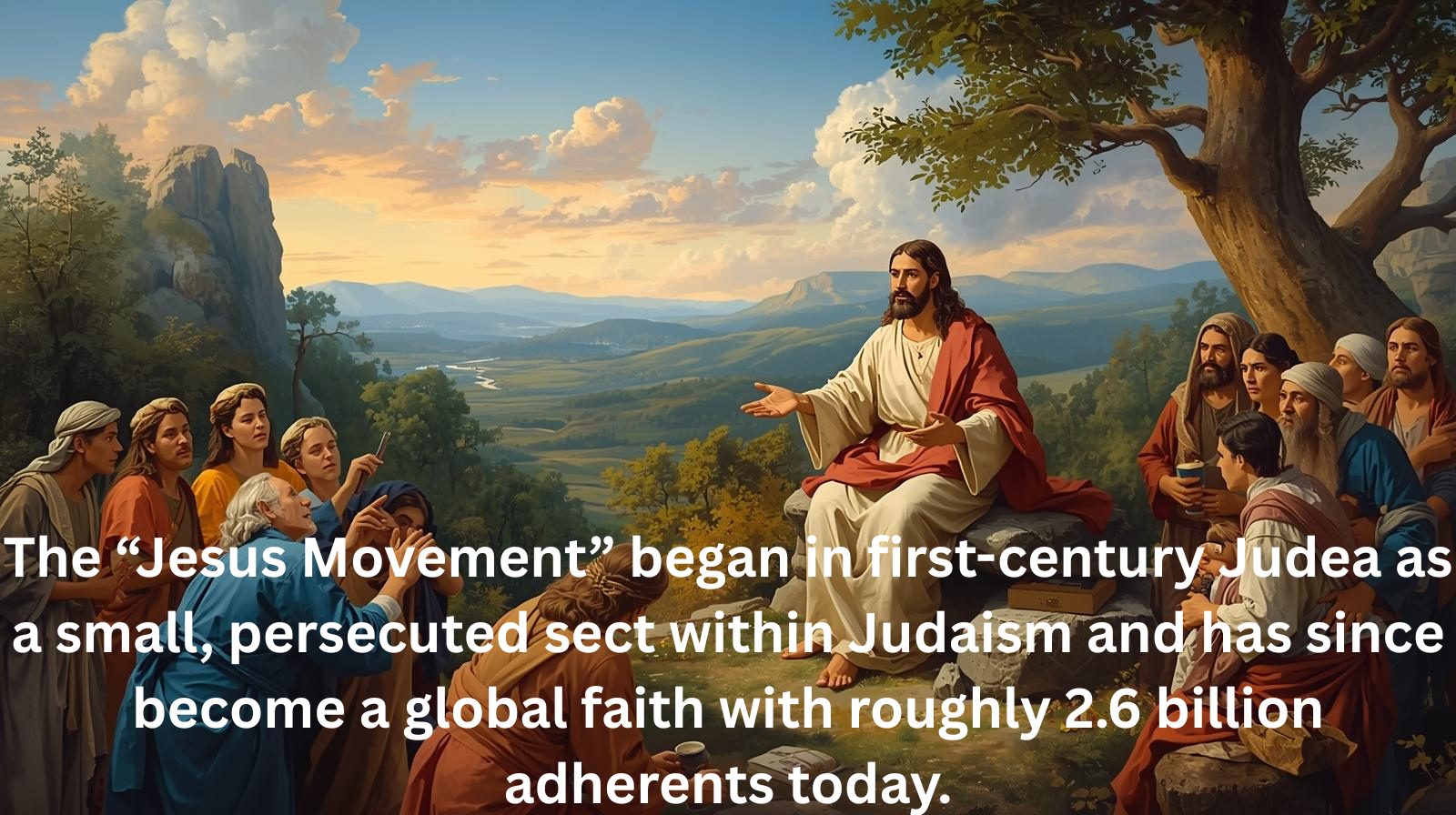
The “Jesus Movement” began in first-century Judea as a small, persecuted sect within Judaism and has since become a global faith with roughly 2.6 billion adherents today. Its growth is extraordinary: Christianity expanded without state-building, without armies, and for its first three centuries, often against political power.
This article explores:
- How Christianity grew in the absence of political power
- Why its expansion differed from Islam’s state-building model
- Compulsion vs. witness: contrasting methods of religious spread
- Jesus’s connection to the Old Testament
- Divine vs. historical movements
- The transcendent dimension
- Cultural transformation
- The role of missionaries
- How Christianity reached billions
1) How Did Christianity Grow in the Absence of Political Power?
For nearly 300 years, Christians lacked political authority and were often persecuted under Roman Law. Yet the movement spread through:
- Personal networks: family, trade, diaspora communities
- Local assemblies: churches offering mutual aid and identity
- Portable scripture: Hebrew Scriptures and apostolic writings
Distinctive practices—charity, integrity, and courage under persecution—made Christianity compelling. Its growth was rooted in grassroots, relational, and sacramental efforts, emphasizing moral authority over political power, thereby inspiring a sense of shared purpose among the audience.
2) Christianity vs. Islam: Two Different Models
Islam, emerging in the 7th century, spread rapidly through unified spiritual and socio-political leadership, integrating Law and governance with faith. Christianity’s archetypal growth was voluntary and persuasive, centered on conversion of the heart, not compulsion (by force),
3) Did Jesus Have Earlier Teaching?
Yes. Jesus’s message is deeply rooted in the Old Testament, fulfilling the Law and the Prophets and reframing identity around himself rather than ethnicity or temple cult.
4) Divine vs. Historical Movements
Sociological and political causes can explain historical movements. Divine movements, in Christian understanding, involve God’s agency—grace, revelation, providence—beyond natural causation.
5) The Transcendent Dimension
Transcendence refers to realities beyond the material—God’s holiness, eternal life, and ultimate meaning. In Christian theology, God is beyond and independent from creation, yet also immanent. This dimension explains why a non-coercive witness can outlast empires: conviction rooted in eternity gives courage under suffering.
6) Cultural Transformation
Christianity shaped:
- Human dignity and rights: Imago Dei undergirded abolition and social reform
- Education and literacy: Monastic schools and universities
- Care and medicine: Hospitals and organized charity
- Law and ethics: Sanctity of life and justice principles
- Art and science: Inspiring creativity and intellectual inquiry
7) The Role of Missionaries
Missionaries were pivotal in Christianity’s global reach:
Apostolic Era: Paul and the First Missionaries
Paul targeted urban centers like Corinth and Rome, leveraging trade routes and diaspora synagogues.
Jesuits and Global Reach
In the 16th century, Jesuits exemplified disciplined mission work:
- Education: Schools and universities shaped elites
- Adaptation: Matteo Ricci in China mastered the language and Confucian thought
- Scientific exchange: Jesuits introduced Western astronomy and math
Protestant Missions: Hudson Taylor
The 19th century saw Protestant missions surge:
- Hudson Taylor pioneered cultural immersion in China, adopting Chinese dress and language
- Bible translation empowered local believers
- Holistic care: Medical and educational work built trust
Modern Trends
- Global South leadership: Africa, Asia, and Latin America now drive growth.
- Digital evangelism: Radio, TV, and online platforms
- Holistic development: Healthcare, microfinance, and empowerment
Missionaries were never just preachers—they were educators, translators, and social innovators, enabling Christianity to cross linguistic and cultural boundaries.
8) How Did Christianity Reach 2.6 billion Followers?
Growth occurred in phases:
- Early Church: Urban networks and house churches
- Imperial Era: Legal toleration and councils
- Medieval Missions: Monastic and parish systems
- Modern Missions: Printing press, global outreach
- Contemporary: Indigenous leadership and digital platforms
Core drivers: compelling message, community care, Scripture translation, adaptability, and non-coercive witness.
Global Christian demographics (2025) based on the latest research from the Center for the Study of Global Christianity and Pew Research:
|
Region |
Christians (millions) |
% of Global Christians |
|
Africa |
~718 |
27.6% |
|
Latin America |
~601 |
23.1% |
|
Europe |
~550 |
21.1% |
|
Asia |
~400 |
15.4% |
|
North America |
~277 |
10.6% |
|
Oceania |
~29 |
1.2% |
|
Middle East |
~13 |
0.5% |
|
Total |
~2.6 billion |
100% |
Key Trends:
- Global South dominance: 69% of Christians now live in Africa, Asia, and Latin America; projected to reach 78% by 2050.
- Africa leads: Africa surpassed Latin America in 2018 as the continent with the most Christians.
- Decline in Global North: Europe and North America show negative growth rates (-0.54% and -0.14% annually).
- Middle East shrinkage: From 13% Christian in 1900 to just 4% today.
Closing Thought
Christianity’s distinctive path—weakness rather than force, witness rather than compulsion, transcendent hope rather than political conquest—can inspire the audience with confidence that enduring transformation flows from love of God and neighbor, not political power.
References
- Hall, T.C. Christianity and Politics: The Hope of the Early Church. University of Chicago Press [journals.u...hicago.edu]
- Lunn-Rockliffe, S. Early Christian Political Philosophy. Oxford Academic [academic.oup.com]
- Dreyer, W.A. The Amazing Growth of the Early Church. HTS Theological Studies [scielo.org.za]
- Hsia, R. A. Jesuit in the Forbidden City: Matteo Ricci 1552–1610. Oxford University Press [academic.oup.com]
- So, W.Y. The Passion, Vision and Strategy of Hudson Taylor [sosir.org]
- Pew Research Center. Global Christianity: Size and Distribution [pewresearch.org]
- Center for the Study of Global Christianity. Status of Global Christianity 2025 [gordonconwell.edu]
- Gospel Coalition. Divine Transcendence and Immanence [thegospelc...lition.org]
- Wikipedia. Role of Christianity in Civilization [en.wikipedia.org]