Summary
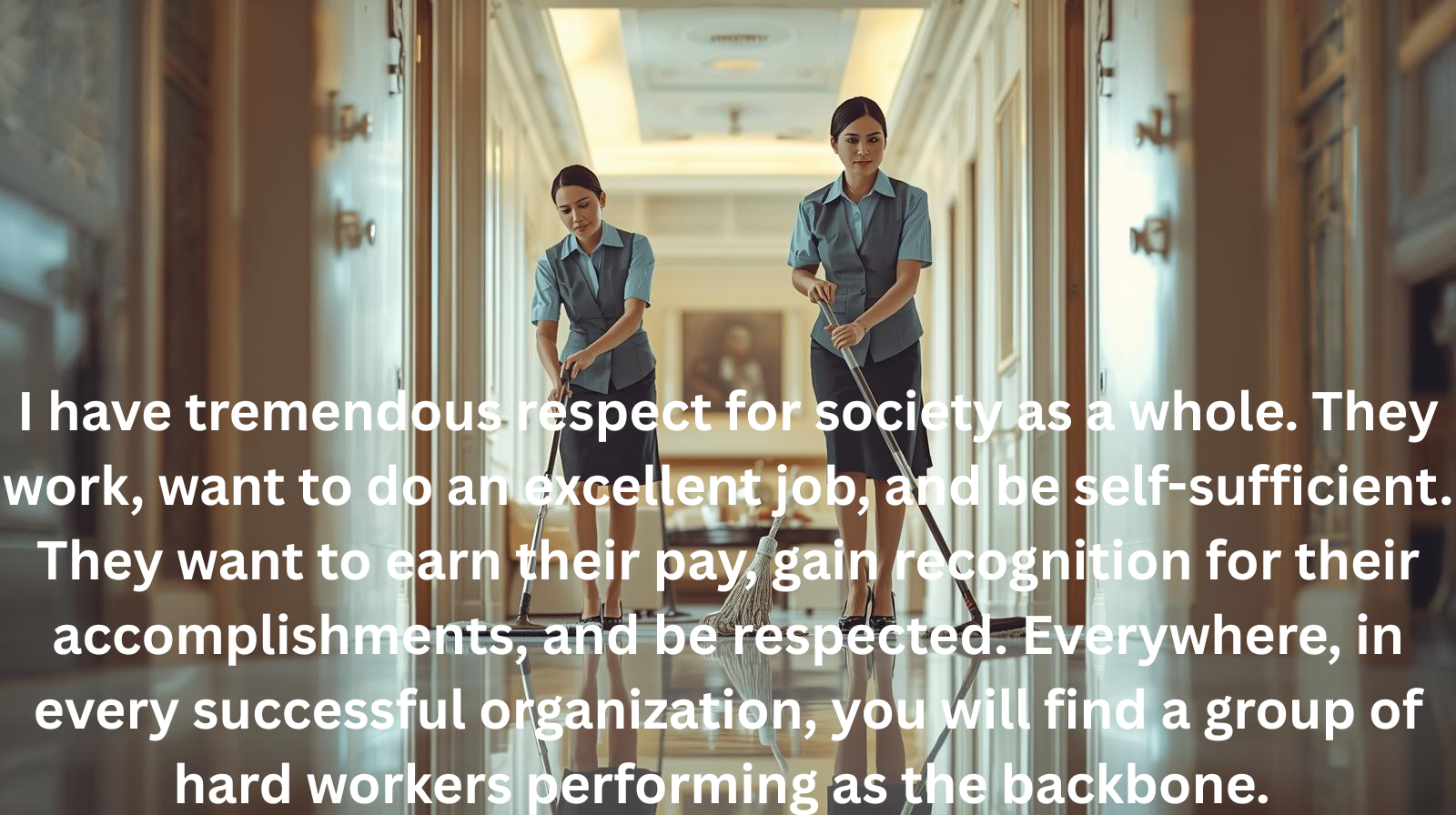
I have tremendous respect for the hard-working cohort of America. They work, want to do an excellent job, and be self-sufficient. They want to earn their pay, gain recognition for their accomplishments, and be respected. Everywhere, in every successful organization, you will find a group of hard workers performing as the backbone.
Generally, they do not intend to be bureaucratic in their methods but rather to conform to a company culture when one exists. They are more likely to circumvent the bureaucratic culture to accomplish their task, with pride.
Every leader and every organization must be aware of the importance of their position within the organization and provide both praise and feedback for their accomplishments.
In every organization, on every jobsite, and across every industry, there is a quiet force that sustains the entire system. They are not the ones at the podium, nor the ones whose names appear in press releases. They are the people who show up early, work hard, solve problems without applause, and carry the weight of daily operations.
We call them “Hard Workers,” and recognizing their virtues of selflessness, versatility, and endurance can foster respect and admiration, thereby prompting readers to appreciate their vital role in society.
Far from being a belittling metaphor, the term captures a universal truth: the strength of any community, business, or economy rests on the countless individuals who make progress possible through collective effort, inspiring a sense of unity in readers.
Professional Reality: The Backbone of Every Organization. In the workplace, the “Hard Worker” represents the diligent, reliable contributor whose collective effort keeps operations running and whose value is often understated but essential.
In the workplace, the “Hard Worker” represents the diligent, reliable contributor whose value is often understated but essential.
The Diligent Employee
These individuals perform the groundwork—literal or figurative—that keeps operations running. They answer phones, manage logistics, operate machinery, enter data, maintain customer relationships, and handle the steady flow of tasks that executives rely on but do not see.
They are not searching for titles or applause.
They take pride in competence, consistency, and responsibility.
Their work ethic is the invisible glue that holds entire businesses together.
The Unspoken Challenge of Low Status
Yet in many environments, the same people doing the heaviest lifting often hold the lowest-ranking positions. They may be described—sometimes dismissively—as “cogs in the machine.” This framing misses the point entirely. A machine is only as strong as its gears, and when the smallest gear fails, everything stops.
The human hard worker performs the labor on which many depend, but few acknowledge.
Recognizing their contributions fosters:
- Respect for the difficulty of their work
- Gratitude for the reliability they provide
- Awareness of the physical and emotional toll their jobs may take
Honoring the hard worker is ultimately about celebrating the foundation of productivity itself.
A Modern Twist: The “Hard Worker” in Gaming Culture
Unexpectedly, the metaphor has also entered digital culture.
The Metaphorical Power: Virtues of the Hard Worker
The term “Hard Worker” may sound simple, but it carries profound meaning. Real hard workers display extraordinary characteristics—and humans described this way often embody similar virtues.
1. Selflessness and Collective Purpose
A hard worker does not act for personal glory. Its purpose is tied to the health of the hive.
Likewise, a hard worker works for the benefit of the team, the company, or the community. They ensure the group succeeds—even if their contribution goes unrecognized.
This type of selflessness is one of the rarest and most admirable traits in the modern workplace.
2. Versatility and Adaptability
Real hard worker perform different jobs throughout their life: cleaning, nursing, building, guarding, and foraging. They step into whatever role the hive needs most.
Human workers exhibit the same versatility.
They:
- Learn new skills on the job
- Fill gaps in the workflow
- Adapt quickly to changing priorities
- Serve as problem-solvers and steady hands during a crisis
Organizations depend on these flexible, multitalented individuals far more than they realize.
3. Strength and Physical Endurance
Many hardworking jobs are physically demanding. Laborers, construction workers, warehouse staff, field technicians, health aides, and countless others carry out tasks that require stamina and resilience. The physical toll is real, often invisible, and routinely underestimated.
Recognizing the “hard worker” also acknowledges the sacrifices inherent in many essential jobs, fostering empathy and gratitude for the physical and emotional resilience that supports families, cities, and entire economies.
Why the Hard Workers Matter More Than Ever
In an age dominated by personal branding, instant visibility, and the chase for status, the hard worker stands as a reminder of something increasingly rare: a commitment to substance over appearance.
Hard workers ground us.
They humble us.
They illustrate that progress, progress—whether in a factory, an office, a community, or an economy—comes from steady, persistent, collective effort.
At a time when automation, remote work, and digital platforms change how society functions, the value of human reliability and dedication becomes even more pronounced. Machines may replicate tasks, but they cannot replicate character. They cannot replace work ethic, determination, or integrity.
The Hard worker embodies all of these.
The Case for Celebration
If society is built on the backs of hardworking people, then they deserve not only recognition but also respect.
This means:
- Giving credit for unseen labor
- Elevating the status of essential jobs
- Appreciating the moral and physical weight of demanding work
- Encouraging gratitude instead of entitlement
- Understanding that leadership begins with service
To call someone a hard worker is not an insult—it is a tribute.
It acknowledges the quiet strength of individuals who push humanity forward one task, one shift, one step at a time.
Closing
“A hard worker is not defined by rank but by devotion—one of the rare individuals whose steady effort keeps the world turning, even when no one is watching.”
Ultimately, the hard worker reminds us of a truth too easily forgotten: society is not sustained by titles or headlines, but by the steady commitment of ordinary people doing extraordinary work every single day. Their hands build our cities, their discipline keeps our institutions functioning, and their uncelebrated persistence moves the world forward in ways applause will never fully capture. To honor the hard worker is to celebrate the very foundation of progress itself—because when the quiet contributors thrive, the whole hive rises with them.
Alternative Names for Hard Workers
Positive Metaphors
- Workhorse
- Backbone of the team
- Engine of the operation
- Steady hand
- The glue that holds things together
- The unsung hero
- The quiet powerhouse
- The lifeblood of the company
- The foundation builders
Common Workplace Terms
- Go‑to the person
- Dependable performer
- High-output contributor
- Top producer
- Consistent performer
- Solid operator
- Heavy lifter
- Task master
- Problem solver
- Frontline worker
- Essential staff
Blue‑Collar / Labor-Oriented Terms
- Tradesman/tradeswoman
- Hands-on worker
- Boots-on-the-ground worker
- Field worker
- Craftsman/craftswoman
- Manual worker
- Production worker
- Operator
- Journeyman/journeywoman
Culturally Familiar Expressions
- The salt of the earth
- Nose‑to‑the‑grindstone type
- Put‑your-head-down-and‑work type
- Everyday hero