Overview
Few dog breeds have lived through a reputational arc as dramatic as the German Shepherd. Forged in the late 19th century for hard, honest work, the breed became a battlefield fixture in two world wars, suffered backlash for its “German” identity after 1945, and then—thanks in no small part to Hollywood’s most excellent canine star—rose to become a global emblem of loyalty, intelligence, and public service. This historical narrative traces that journey: the wartime roles that shaped the German Shepherd’s image, the post-WWII challenges to its acceptance, and the cultural rehabilitation catalyzed by Rin Tin Tin.
Origins: A Working Dog Built for Purpose
The German Shepherd’s story begins with Captain Max von Stephanitz, who in 1899 set out to standardize a superior working dog capable of herding, guarding, and service roles. His vision, anchored by the foundational stud Horand von Grafrath, prioritized utility over show, shaping a breed renowned for intelligence, drive, and steadiness.
Von Stephanitz’s philosophy, often distilled into a single maxim, set the tone for the breed’s identity: “Utility is the true criterion of beauty.” That ethos—work first, appearance second—guided early police and military trials in Germany and prepared the breed for modern service.
World War I: Baptism by Fire
When WWI broke out, German Shepherds entered modern warfare in organized numbers. They ran messages across dangerous terrain when human couriers were vulnerable, guarded depots, and aided medics by locating wounded soldiers; accounts note their work guiding blinded men to safety, an origin story for later guide‑dog programs.
Allied troops, initially skeptical, grew impressed by the dogs’ courage and usefulness under fire. Exposure on the Western Front seeded international fascination with the breed, which several countries—including the United States—would cultivate in the interwar period.
Between the Wars: Fame and Foundations
The interwar years saw two trends intertwine: institutional interest in the German Shepherd’s versatility and popular fascination with heroic dogs. In police work and civil defense, the breed’s trainability and high “work drive” kept it in demand. At the same time, cinema elevated canine stars, and one German Shepherd—rescued as a five-day-old puppy from a shattered kennel in France—soon eclipsed them all: Rin Tin Tin.
Lee Duncan, an American airman, found the puppy in September 1918 near Flirey, France, named him after French good‑luck dolls (“Rin Tin Tin” and “Nanette”), and brought him to the United States. Within a few years, “Rinty” was headlining silent features at Warner Bros., acting set‑pieces that reportedly helped stabilize the studio’s finances during a precarious era.
Film historian Kathryn Fuller‑Seeley captures the 1920s moment: “Dog heroes were top American action‑film stars.” Rin Tin Tin’s persona—brave, intuitive, protective—etched the German Shepherd into the American imagination as a noble ally. He appeared in more than two dozen films, drew sacks of fan mail, and set a template for canine stardom that later migrated to radio and television.
World War II: Service on All Sides
As WWII escalated, German Shepherds again served in large numbers. Germany fielded them across military and police roles; the United States, learning from foreign practice and its own interwar experiments, expanded breed use in messengering, guarding, search, and rescue. Specialized training centers emerged in the early 1940s, and by 1944, the U.S. Army had narrowed the accepted breeds—German Shepherds remained core to the program.
On the battlefield and the home front, the dogs’ reliability bolstered their reputation as working partners. Yet the postwar cultural landscape would complicate that image. The breed’s very name—German Shepherd—carried political baggage in societies scarred by Axis aggression, and in some places, it revived earlier renaming practices meant to dilute “enemy” associations.
The Post‑WWII Plight: Stigma, Renaming, and Policy Headwinds
The backlash after 1945 took different forms. In the United Kingdom, an earlier WWI‑era renaming—“Alsatian Wolf Dog”—persisted long after WWII, reflecting anti-German sentiment. It took decades to restore the breed’s original name; the Kennel Club shifted the nomenclature to “German Shepherd Dog (Alsatian)” in 1977 and finally removed “Alsatian” altogether in 2010.
Public ambivalence is also manifested through regulation. As dog‑bite fears periodically spiked, municipalities experimented with breed-specific restrictions—most commonly targeting Pit Bulls but often including German Shepherds alongside Rottweilers and Dobermans. Veterinary associations and animal Law scholars have since criticized such laws as ineffective and discriminatory. Yet, their patchwork presence has created uncertainty for owners and breeders in the postwar decades and beyond.
Globally, restrictions—ranging from muzzling requirements to import bans—have at times included German Shepherds. While the details vary widely by jurisdiction and change over time, the political optics of “guard dog breeds” have periodically led to the German Shepherd being listed as a “regulated” or “dangerous” dog in different countries.
Rin Tin Tin’s Enduring Counter-Narrative
Against that backdrop, Rin Tin Tin’s legacy mattered profoundly. Though the original dog died in 1932, the name continued through successors and through a mid-century television revival, The Adventures of Rin Tin Tin (1954–1959), which brought the heroic German Shepherd archetype into living rooms across the United States.
The show’s frontier-adventure format, pairing a valiant dog with a young boy and set in a U.S. Cavalry setting, bridged nostalgia and modernity. It reinforced an image of the German Shepherd as a steadfast protector of the vulnerable—a trope with deep appeal in a nation navigating Cold War anxieties and suburban growth.
Rin Tin Tin’s cultural influence is visible in American Kennel Club popularity trends. AKC historical summaries indicate German Shepherds ascended to the top U.S. breed slot in 1925 at the height of Rinty’s film fame, then remained among the most popular breeds across subsequent decades—even as other breeds cycled through the No. 1 position.
By the 1950s, the Beagle led overall. Still, German Shepherds stayed entrenched in the public’s top‑ten consciousness—a durable prestige owed partly to media heroes and to the breed’s expanding roles in police and service work.
Beyond Entertainment: Institutional Rehabilitation
The Renaissance was not merely cinematic. After WWII, German Shepherds became pillars of professional K-9 units in North America and Europe. Police departments prized their balance of power, trainability, and temperament; search‑and‑rescue teams leveraged their scenting and endurance; and guide‑dog programs drew on their ability to work calmly in complex environments—roots traced by some historians to WWI battlefield experience guiding injured soldiers.
The U.S. military’s formalization of working‑dog programs also helped normalize large shepherd breeds as disciplined public servants rather than domestic threats. Government histories trace modern MWD (Military Working Dog) structures back to lessons learned from European wartime practice, professionalizing a field that sustained German Shepherd demand well into the late 20th century.
In parallel, breeders and trainers refined lines for different purposes—working versus show—while advocacy around responsible ownership and behavior-based regulation pushed back against breed bans. Every heroic depiction of a trained German Shepherd—on screen or in uniform—made it harder to sustain blanket stigmas.
Historians in Their Own Words
- Max von Stephanitz (breed founder): “Utility is the true criterion of beauty.” (1925)
- Kathryn Fuller‑Seeley (film historian): “Dog heroes were top American action‑film stars in the 1920s.”
- Susan Orlean (cultural historian of Rin Tin Tin): “Dogs… were perfect heroes: unknowable but accessible.”
These succinct lines help frame the breed’s trajectory—from a utilitarian ideal (Stephanitz), through mass culture heroism (Fuller-Seeley), to enduring symbolic power (Orlean).
The Cultural Mechanics of Redemption
Why did Rin Tin Tin resonate so profoundly with postwar audiences, and why did that resonance stick? Part of the answer lies in the paradox of the silent‑film star whose emotions are read across species and languages. In the 1920s, critics remarked that Rin Tin Tin often outperformed his human co-stars; in the 1950s television era, the dog’s heroism translated into a wholesome, family-friendly archetype. In both cases, the German Shepherd’s body language—alert eyes, athletic leaps, protective stances—communicated trustworthiness without political baggage.
Moreover, the narrative of rescue and training—an orphaned puppy, nurtured by a soldier, who then “saves” people on screen—mirrored the broader American story of retooling wartime experience into peacetime institutions. The breed became a symbol of harnessed strength: the capacity to channel formidable ability through discipline and service.
Afterlife: A Breed at the Center of Modern Service
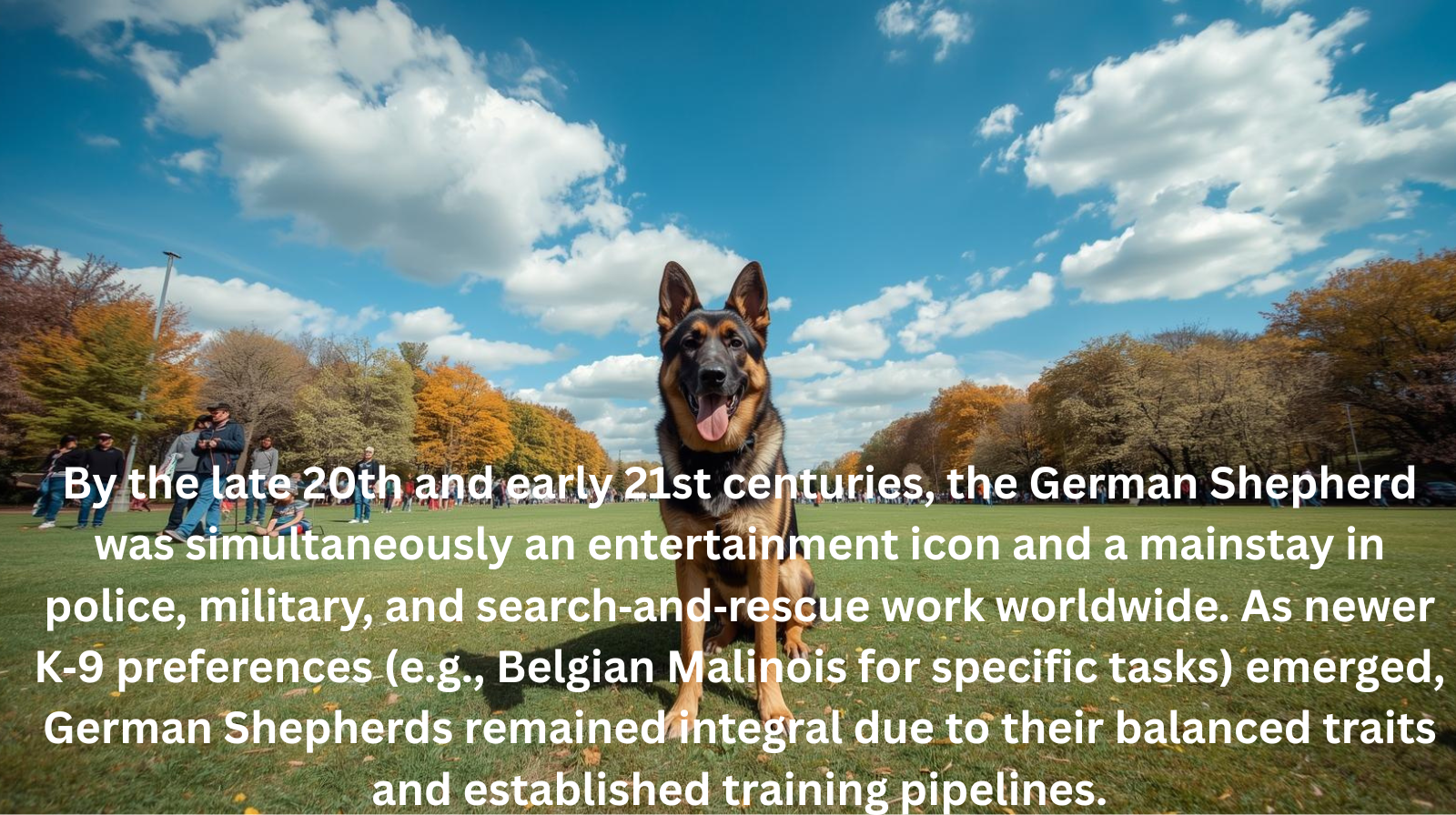
By the late 20th and early 21st centuries, the German Shepherd was simultaneously an entertainment icon and a mainstay in police, military, and search‑and‑rescue work worldwide. As newer K‑9 preferences (e.g., Belgian Malinois for specific tasks) emerged, German Shepherds remained integral due to their balanced traits and established training pipelines.
Rin Tin Tin’s lineage, stewardship, and brand extended through breeders and memorabilia, sustaining public interest and the “good ambassador” role. Media features and breed histories continue to track the line’s ceremonial and therapy work, underscoring the dog’s place in civic life beyond the spotlight.
Reconciling Shadows and Light
To be sure, the breed’s post-WWII “afterlife” is not free of controversy. Some jurisdictions still experiment with breed-specific rules, often driven by insurance practices or by friction between urban policy and practice. Scholarly and veterinary consensus increasingly urges behavior-based approaches over blanket bans, but the legal mosaic remains uneven. The German Shepherd’s journey thus becomes a case study in how a working animal’s public meaning is shaped by war, media, Law, and community norms.
Yet the long arc bends toward appreciation. Institutions that measure breed popularity and public affection show the German Shepherd staying near the top for more than a century, with peaks aligning with key cultural moments—Rin Tin Tin’s screen triumphs in the 1920s and the mid-century television revival, and the expansion of organized K-9 service thereafter.
Conclusion: From “Enemy Dog” to Trusted Partner
The German Shepherd’s “afterlife” following WWII—its passage from suspicion to esteem—captures how societies renegotiate symbols in the wake of conflict. Initially tarred by association with a defeated nation, the breed’s reputation recovered through the visible, everyday service of disciplined dogs and through the robust mythmaking of entertainment. Rin Tin Tin, rescued from war and rescuing others on screen, provided a master narrative of redemption that audiences embraced.
Today, whether patrolling a city street, searching a disaster site, guiding a blind handler, or captivating a child on a screen, the German Shepherd embodies a paradox reconciled: strength without menace; loyalty with independence; once fraught History, now largely honored. That transformation didn’t happen overnight, nor was it accidental. It was built by trainers and handlers, by institutions that valued capability over stereotype, and by one unforgettable dog whose performances reminded millions that courage and kindness can wear a sable coat.
Sources & Further Reading (for your footnotes)
- Breed & service histories: MWDTSA—“German Shepherd Dogs in the Military” (WWI/WWII roles). [mwdtsa.org]
- Government History of MWD programs: U.S. DOD News—“War Dogs: How WWI Led to the Military Working Dog Program.” [war.gov]
- Rin Tin Tin biographies & overviews: Encyclopaedia Britannica—“Rin Tin Tin”; Wikipedia summary. [britannica.com], [en.wikipedia.org]
- Film History framing: Stanford Humanities Center—Fuller‑Seeley, “The Dogs Who Saved Hollywood.” [shc.stanford.edu]
- AKC popularity context: AKC “Top 10 Breeds of the 1950s”; PetPlace historical registration note on 1925 peak. [akc.org], [petplace.com]
- UK naming & renaming: National Purebred Dog Day—“When a Breed’s Name Changes…” [nationalpu...dogday.com]
- BSL & policy: AAHA NewStat—“Breed bans and the human‑animal bond”; Animal Legal & Historical Center—breed‑specific legislation overview. [aaha.org], [animallaw.info]
- Rin Tin Tin cultural quotes: Susan Orlean—Rin Tin Tin: The Life and the Legend (quoted via Goodreads/LibQuotes). [goodreads.com], [libquotes.com]
- Von Stephanitz’s primary principle (utility/beauty): Angelplace, citing The German Shepherd Dog in Word and Picture (1925). [angelplace.net]