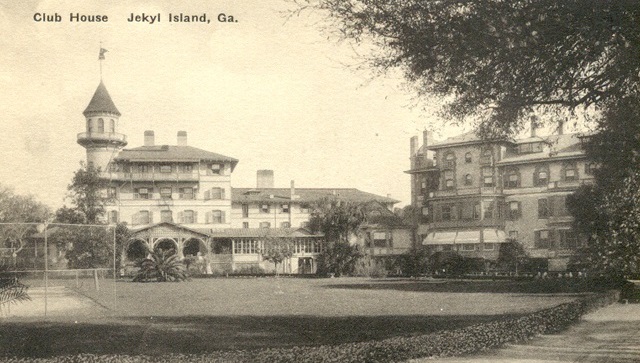
Summary
G. Edward Griffin's non-fiction book, The Creature from Jekyll Island: A Second Look at the Federal Reserve, is a critical exposé that argues the U.S. Federal Reserve System is a banking cartel that acts against the public interest. The book presents the creation of the Federal Reserve as a "blatant scam" orchestrated by a small group of powerful bankers and a U.S. Senator during a secret meeting on Jekyll Island, Georgia, in 1910.
https://www.historichotels.org/us/hotels-resorts/jekyll-island-club-resort/history.php
Publication & Context
- First published in 1994, with multiple reprints (5th edition in 2010).
- The book gained renewed attention during the 2008 financial crisis and Ron Paul’s campaign to abolish the Federal Reserve.
- It is widely regarded as controversial, blending historical analysis with conspiracy theories about banking elites and global governance.
- To better understand the book’s credibility, consider how Griffin’s claims are viewed by mainstream economists and historians, and identify which parts are supported by evidence versus speculation.
Core Premise
Griffin argues that the Federal Reserve System, created in 1913, was not designed to stabilize the economy but to serve the interests of powerful banking elites.
He claims:
- The Fed was conceived during a secret meeting in 1910 on Jekyll Island, Georgia, attended by influential bankers and politicians.
- Its true purpose: protect private banking interests, enable fiat money creation, and consolidate financial power.
Key Themes & Arguments
· Seven Reasons to Abolish the Federal Reserve
o It fails to achieve its stated objectives.
o Operates for private interests, not the public good.
o Encourages inflation (seen as an “unfair tax”).
o Promotes war and global instability.
o Functions as an instrument of totalitarian control.
· The Mandrake Mechanism
o Griffin’s term for how the Fed creates money “out of nothing” by converting government debt into currency.
o He argues this system leads to economic chaos and perpetual debt.
· Global Conspiracy Narrative
o Suggests the Fed is part of a broader plan for world government and a global fiat currency, facilitated by institutions like the IMF and World Bank.
· Historical Impact
o Claims the Fed has destabilized the economy, enabled risky banking practices, and contributed to cycles of boom and bust.
o Links central banking to major wars and political manipulation.
Tone & Style
- Reads like a detective story, blending historical events with speculative theories.
- Appeals to readers skeptical of government and central banking.
- Frequently cited in libertarian and anti-Fed circles.
Criticism
- Mainstream economists and historians reject Griffin’s claims as conspiratorial and factually flawed.
- The book is influential among those advocating sound money (e.g., Gold standard) and abolition of the Fed, but is not considered authoritative in academic circles.
Chapter-by-chapter overview of The Creature from Jekyll Island by G. Edward Griffin, based on study guides and summaries:
Section I: What Creature Is This?
· The Journey to Jekyll Island
o Describes the secret 1910 meeting of elite bankers and politicians on Jekyll Island, Georgia, where the blueprint for the Federal Reserve was drafted.
· The Name of the Game Is Bailout
o Explains how the Fed protects banks through bailouts, encouraging risky lending.
· Protectors of the Public
o Critiques the claim that the Fed serves the public interest, arguing it benefits private banking elites.
· Home Sweet Loan
o Discusses fractional-reserve banking and its role in creating credit expansion. 5–6. Nearer to the Heart’s Desire: Building the New World Order
o Introduces Griffin’s thesis that the Fed is part of a global plan for centralized economic control.
Section II: A Crash Course on Money
· The Barbaric Metal
o Examines Gold as “real money” and contrasts it with fiat currency.
· Fool’s Gold
o Explains why fiat money systems are inherently unstable.
· The Secret Science
o Details the mechanics of money creation.
· The Mandrake Mechanism
o Griffin’s term for how government debt is converted into money “out of nothing.”
Section III: The New Alchemy
· The Rothschild Formula
o Argues that powerful families profit from financing both sides of wars.
· Sink the Lusitania!
o Suggests banking interests influenced U.S. entry into WWI. 13–15. Masquerade in Moscow; The Best Enemy Money Can Buy; The Lost Treasure Map
o Links banking systems to global conflicts and ideological manipulation.
Section IV: A Tale of Three Banks
· The Creature Comes to America
o Traces the evolution of central banking in the U.S.
· A Den of Vipers
o Discusses early banking scandals.
· Loaves and Fishes, and Civil War
o Explores Civil War-era monetary policies.
· Greenbacks and Other Crimes
o Critiques government-issued currency during wartime.
Section V: The Harvest
· The London Connection
o Examines ties between U.S. and European banking elites.
· Competition Is a Sin
o Argues that monopolistic banking practices were intentional.
· The Creature Swallows Congress
o Details the political influence of banking interests.
· The Great Duck Dinner
o Allegorical chapter on Corruption and collusion.
Section VI: Time Travel into the Future
· Doomsday Mechanisms
o Warns of systemic collapse due to debt and inflation.
· A Pessimistic Scenario
o Predicts global economic turmoil.
· A Realistic Scenario
o Outlines Griffin’s proposed solution: abolish the Fed and return to sound money.
The Mandrake Mechanism is G. Edward Griffin’s term for the process by which the Federal Reserve creates money “out of nothing.” Here’s a clear breakdown:
Core Idea
- The mechanism refers to the conversion of government debt into money, enabling the expansion of the money supply without corresponding production of goods or services.
- Named after the magician Mandrake, symbolizing the illusion of creating something valuable from nothing.
How It Works (According to Griffin)
· Government Issues Bonds
o When the U.S. government needs money beyond tax revenue, it issues Treasury bonds (IOUs).
· Fed Buys Bonds
o The Federal Reserve purchases these bonds, but instead of paying with existing money, it creates new money electronically or prints currency.
· Banks Multiply Credit
o Through fractional-reserve banking, commercial banks use these reserves to create multiple times more credit, further expanding the money supply.
· Result: Inflation & Debt
o Griffin argues that this system:
§ Dilutes the value of existing money (inflation).
§ Creates perpetual debt because the government owes interest on bonds bought with money created from nothing.
Why Griffin Criticizes It
- He sees it as a hidden tax on the public via inflation.
- Believe it benefits banking elites and politicians while harming savers and wage earners.
- Claims lead to boom-bust cycles and systemic instability.
Fractional reserve banking is a system in which banks hold only a fraction of their customers’ deposits in reserve and lend out the rest.
Here’s how it works step by step:
1. Deposits and Reserves
- When you deposit $1,000 in a bank, the bank is required by Law to keep a certain percentage (called the reserve ratio) in reserve, say 10%.
- So the bank keeps $100 and can lend out $900.
2. Lending and Money Creation
- The $900 loaned out is spent and eventually deposited into another bank.
- That second bank keeps 10% ($90) and lends out $810.
- This cycle repeats, creating new money through bank credit.
3. The Multiplier Effect
- Through this process, the original $1,000 deposit can support up to $10,000 in total deposits if the reserve ratio is 10%.
- Formula:
So at 10%, multiplier = 10.
4. Why It Matters
- Pros: Increases liquidity, supports economic growth.
- Cons (Critics like Griffin): Creates systemic risk, inflation, and dependency on debt.