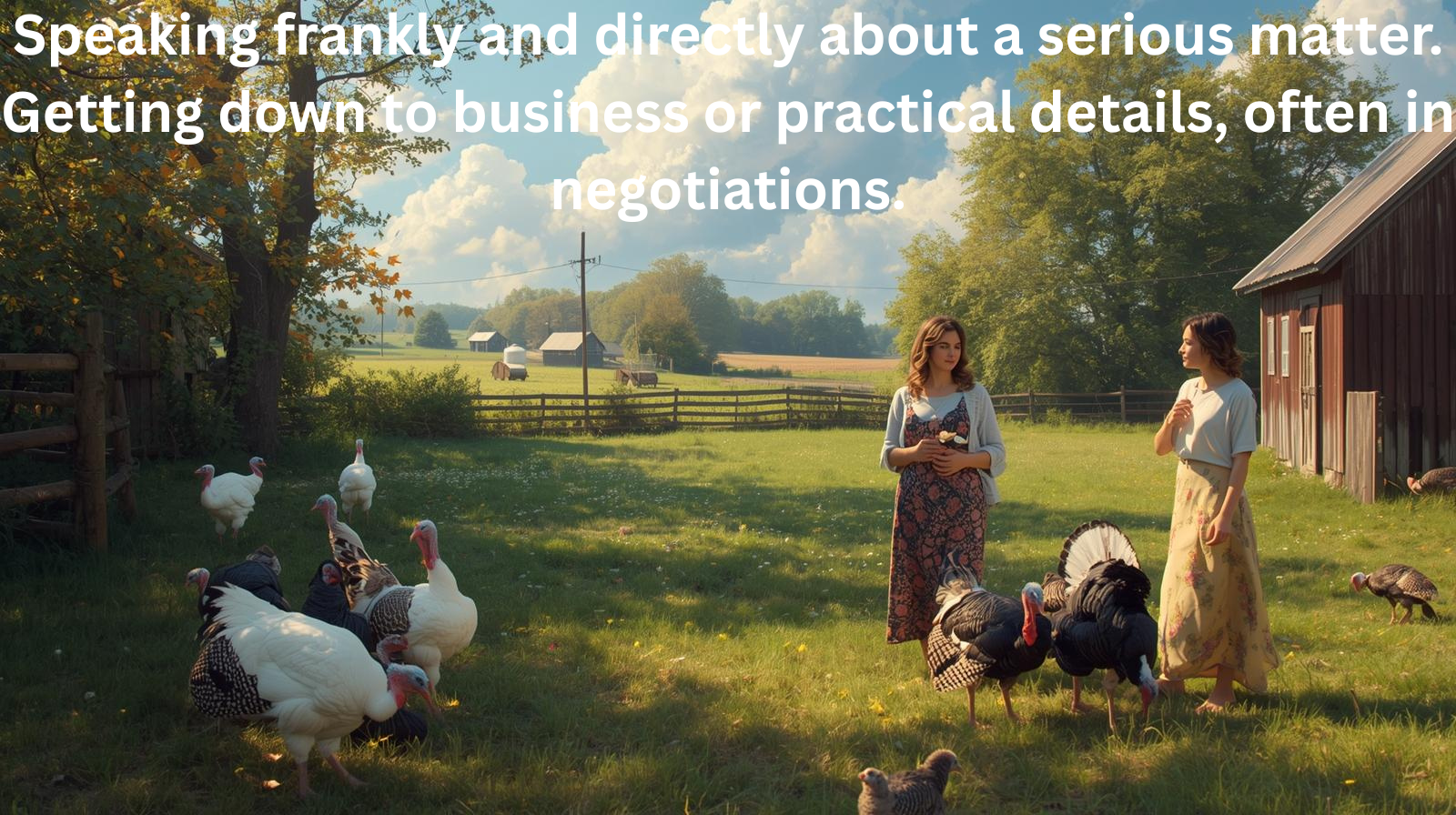
Today, “talking turkey” generally means:
- Speaking frankly and directly about a serious matter.
- Getting down to business or practical details, often in negotiations.
Example: “Enough small talk—let’s talk turkey about the deal.”
History & Origin
- The phrase dates to early 19th-century America.
- It originally referred to honest, straightforward conversation, often about something important or valuable.
- One popular theory ties it to Native American and settler trade stories:
- Settlers and Native Americans would hunt together and then divide the game.
- A humorous anecdote: A settler offered a Native American one turkey and one crow, saying, “You take the crow, I’ll take the turkey.” The Native American replied, “You talk turkey to me, but give me crow.” This became associated with speaking plainly and reasonably.
Evolution
- By the mid-1800s, “talk turkey” was widely used in American English to mean speaking honestly or getting serious.
- Later, it became common in business contexts: “Let’s talk turkey” = let’s discuss real terms, not fluff.
In business contexts, “talking turkey” means moving past pleasantries and focusing on the real, substantive details of a deal or negotiation.
Here’s how it’s typically applied:
1. Negotiations
- When parties say, “Let’s talk turkey,” they signal readiness to discuss:
- Price
- Terms and conditions
- Delivery timelines
- Performance guarantees
- It’s often used to cut through sales fluff or vague promises and get to the bottom line.
2. Sales & Closing Deals
- Sales professionals use it when transitioning from rapport-building to closing the deal.
- Example:
“We’ve discussed the features—now let’s talk turkey about cost and implementation.”
3. Conflict Resolution
- In disputes or contract renegotiations, “talking turkey” means:
- Direct, honest communication
- Avoiding euphemisms or sugarcoating
- Addressing core issues head-on
4. Strategic Planning
- Executives might say it in meetings to shift from vision statements to actionable steps:
“Enough theory—let’s talk turkey about budget allocation.”
Why It Works in Business
- Signals serious intent and transparency.
- Builds trust by showing willingness to discuss specifics.
- Help avoid misunderstandings and wasted time.
Real-world style examples of “talk turkey” in business negotiations, drawn from documented usage and corporate anecdotes:
1. Merger Negotiations
“During a merger meeting, one executive said, ‘Let’s talk turkey and discuss the financial details of this deal”
This signals a shift from high-level strategy talk to complex numbers and valuation terms.
2. Supplier Contract Renegotiation
“It’s time to talk turkey with our suppliers and get a better deal.”
Used when a company moves from general relationship-building to price, delivery schedules, and penalties.
3. Salary Negotiation
“Let’s stop beating around the bush and talk turkey about the salary.”
Common in HR or executive hiring discussions when both sides want to cut through perks and get to compensation figures.
4. Investor Meetings
“Have you talked turkey with the investors about the potential risks involved?”
This phrase often appears when founders need to address risk exposure and ROI expectations directly.
5. Closing a Sales Deal
“We need to talk turkey to finalize this agreement.”
Sales teams use it when moving from product demos and rapport-building to contract signing and payment terms.
Why It’s Effective in Business
- Signals seriousness: Everyone knows the fluff is over.
- Builds trust: Transparency and directness reduce ambiguity.
- Accelerates decisions: Focuses on actionable details.
Do’s and Don’ts guide for using “talk turkey” in business:
✅ DOs
· Use it to signal seriousness
o Example: “We’ve covered the basics—let’s talk turkey about pricing.”
o It shows you’re ready to move from small talk to actionable details.
· Apply it in negotiations or decision-making
o Works well when discussing contracts, budgets, or timelines.
· Keep tone professional and clear
o It’s informal but acceptable in many business settings if used sparingly.
· Pair it with specifics
o Don’t just say “talk turkey”—follow up with what you want to address (e.g., costs, terms).
❌ DON’Ts
· Don’t use it in highly formal or international contexts
o In some cultures, idioms can confuse or seem unprofessional.
· Avoid overuse
o Using it repeatedly can sound gimmicky or insincere.
· Don’t use it without context
o Saying “Let’s talk turkey” without clarifying the subject can leave others guessing.
· Avoid sensitive discussions
o For topics like layoffs or compliance issues, stick to neutral language.
Closing Comment
In business, “talking turkey” is more than an old idiom—it’s a signal of clarity, commitment, and action. When used thoughtfully, it helps cut through the noise and focus on what truly matters: the terms, the numbers, and the decisions that drive results. Whether you’re negotiating a contract, finalizing a deal, or setting strategic priorities, knowing when to “talk turkey” can turn conversations into concrete outcomes.