Activists often employ a mix of technical, social, and strategic methods to bypass censorship.
The U.S. government does not maintain a publicly available, formal, and legally current list of “subversive groups” as it did historically (such as the Attorney General’s List of Subversive Organizations from the Cold War era).
Instead, federal agencies like the FBI and Department of Homeland Security (DHS) focus on monitoring and assessing specific threats, particularly domestic violent extremism (DVE) and foreign terrorist organizations (FTOs), based on violent activity or intent, not political ideology alone. You had better believe that the government knows every one of them, but not for public notice.
Threat assessments in 2024 and 2025 identify the following general threats.
Domestic Violent Extremists (DVEs): These are often lone offenders radicalized online, motivated by a mix of socio-political goals and personal grievances. Common themes animating some of this conduct include anti-Americanism, support for the overthrow of the government, and hostility towards specific demographics or institutions.
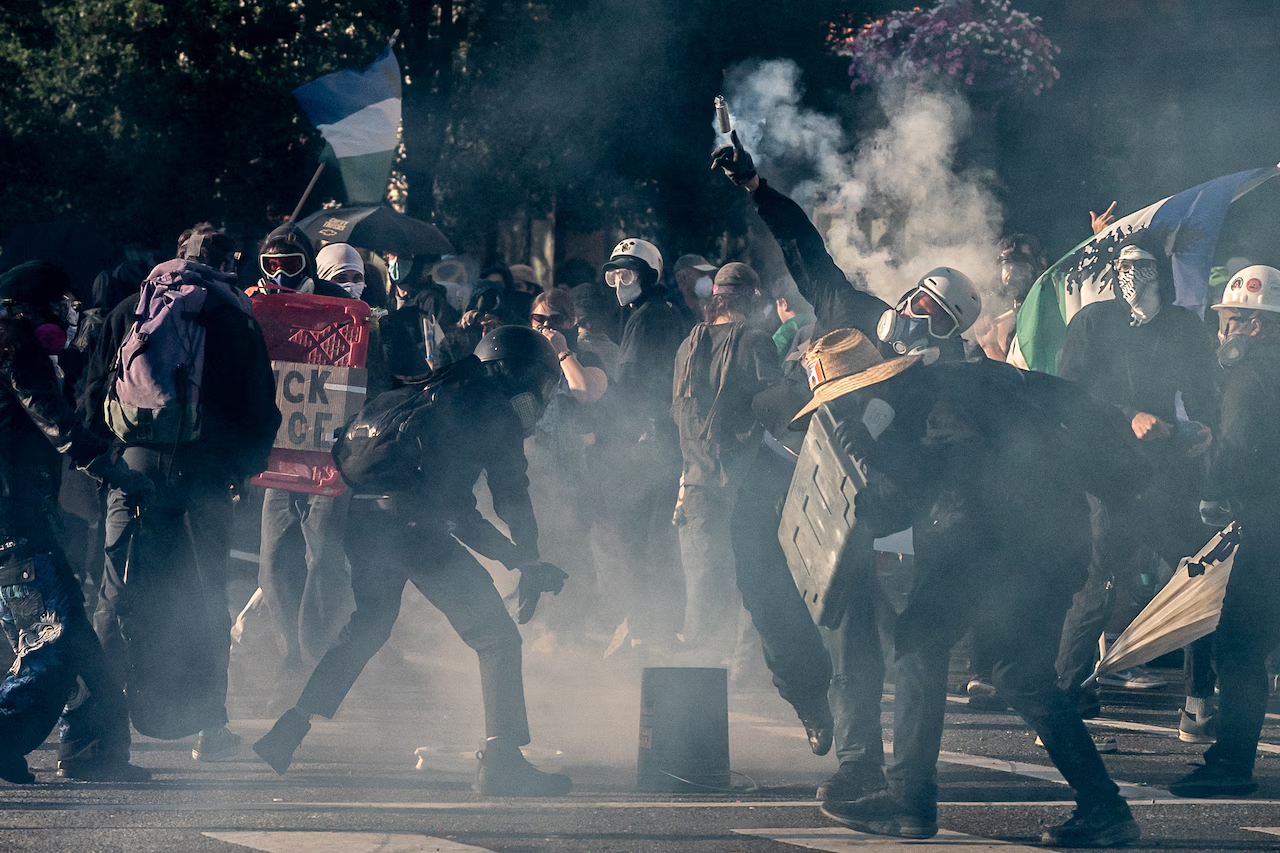
- Antifa: A September 2025 executive order specifically designated Antifa as a domestic terrorist organization, describing it as an enterprise that calls for the overthrow of the U.S. government and uses violence to achieve its goals.
- Foreign Adversaries and their influence: Federal agencies remain concerned about the Impact and activities of foreign nations, such as the People’s Republic of China (PRC), Russia, and Iran, which pose threats to U.S. critical infrastructure (e.g., cyberattacks) and national security.
- Foreign Terrorist Organizations (FTOs) and Inspired Individuals: The U.S. continues to monitor individuals and groups in the U.S. who may be inspired by or directed by FTOs such as ISIS, Al-Qa’ida, and others.
The U.S. government’s focus is on individuals and groups that engage in violence, terrorism, or espionage, rather than simply holding dissenting political beliefs.
Examples of subversive groups:
· Soros’s Open Society Foundation
· Tides Foundation
· Revolutionary Communist Party
· Democratic Socialist of America
· National Socialist Movement
· Freedom Socialist Party
· Black Lives Matter
· Antifa
· Proud Boys
· Oath Keepers
· Patriot Front
· Gay Liberation Front
Here are their main approaches and communication channels to maintain a below-the-radar presence.
1. Technical Workarounds
- VPNs (Virtual Private Networks): Encrypt traffic and mask location to access blocked sites.
- Proxy Servers: Route traffic through intermediary servers to bypass restrictions.
- Tor Network: Provides anonymity and access to censored content via onion routing.
- Mirror Sites: Replicas of blocked websites hosted on different domains.
2. Alternative Communication Channels
- Encrypted Messaging Apps: Signal, Telegram, and WhatsApp for secure coordination.
- Decentralized Platforms: Mastodon or blockchain-based social networks that resist takedowns.
- Peer-to-Peer Sharing: Using Bluetooth, AirDrop, or offline mesh networks during internet shutdowns.
3. Content Obfuscation
- Code Words & Memes: Activists disguise messages in humor or cultural references to evade automated filters.
- Image-Based Text: Posting text as images to bypass keyword detection.
4. International Amplification
- Foreign Hosting: Websites and servers located outside the censoring country.
- Global Media Partnerships: Sharing stories with international outlets to ensure visibility.
5. Resilience Strategies
- Digital Literacy Training: Teaching communities how to use circumvention tools safely.
- Redundancy: Multiple channels and backups to prevent single points of failure.
6. Onion Routing
· https://www.investopedia.com/terms/t/tor.asp
· https://en.wikipedia.org/wiki/Tor_(network)
· Tor routes the internet traffic through multiple volunteer-operated nodes (relays) worldwide.
· Each hop is encrypted, and no single node knows both the origin and destination.
· This layered encryption (like an onion) prevents surveillance and tracking.
2. Access to Blocked Content
- Tor allows users to reach websites that local ISPs or governments block.
- It also enables access to .onion sites (hidden services) that exist only within the Tor network, often used for secure communication.
3. Circumventing IP-Based Blocking
- Since your IP address changes as traffic exits through different Tor nodes, censorship systems that rely on IP filtering fail to identify and block you effectively.
4. Resistance to Deep Packet Inspection
- Tor traffic is encrypted and obfuscated, making it harder for censors to detect and block based on content or protocol signatures.
Limitations
- Speed: Routing through multiple nodes slows down connections.
- Blocking Tor Nodes: Some regimes try to block known Tor entry nodes, but Tor offers bridges (unlisted relays) to bypass this.