Meaning
-
Modern usage
“Shucks,” “Ah, Shucks” is an exclamation.
Origin and meaning: “Shucks” is an interesting one with roots in American English.
Meaning
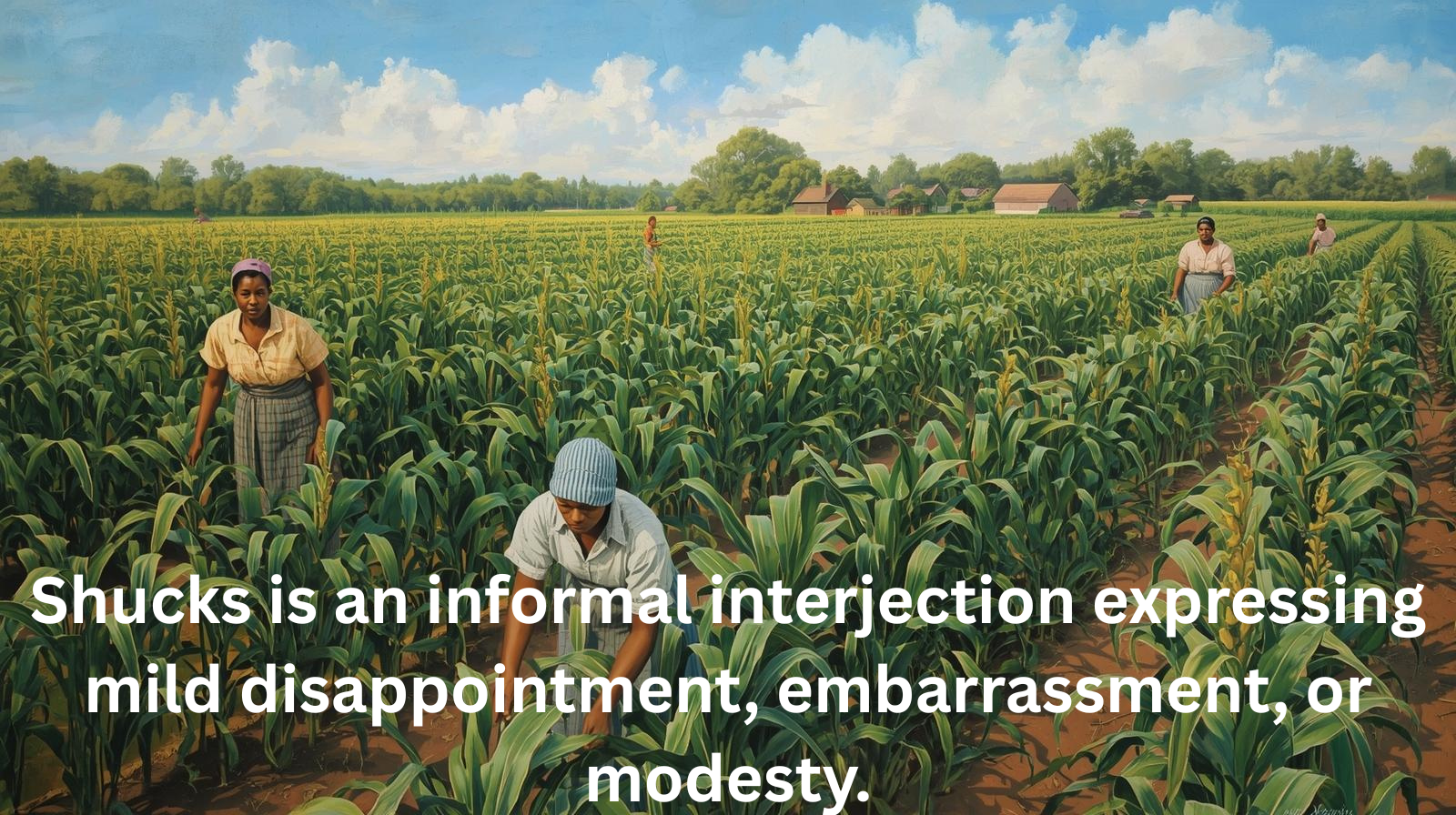
- Modern usage: It’s an informal interjection expressing mild disappointment, embarrassment, or modesty.
- For example:
“Aw, shucks, I didn’t expect that compliment!” - It often conveys a sense of down-home humility or folksy charm, associated with rural or colloquial speech.
Origin
- Etymology: The word initially referred to the outer husk of corn or other grains—the part you peel away.
- Figurative sense: By the mid-19th Century, “shucks” began appearing as a mild oath or exclamation, likely because it was considered trivial or worthless (like corn husks). Saying “shucks!” was akin to saying “that’s nothing!” or “darn!” but in a softer, non-offensive way.
- First recorded use: Around 1847 in American English, primarily in rural dialects.
Mark Twain quotes using “shucks” from his works, especially The Adventures of Huckleberry Finn:
Quotes from Twain
· “Shucks, it ain’t no use to talk to you, Huck Finn. You don’t seem to know anything, somehow—perfect saphead.”
— The Adventures of Huckleberry Finn, Chapter 3 (Tom Sawyer speaking to Huck)· “Aw, shucks, I wasn’t doing nothing.”
— Common Twain dialogue style in Huck Finn, used when Huck downplays his actions (appears in several chapters in dialect passages).· Twain’s fondness for the word:
Literary analysis shows “shucks” was one of Twain’s favorite words, appearing disproportionately in his works, often to convey rural modesty or mild frustration.Quotes from Tom Sawyer
· “Shucks! What do you want to slope for?”
— Tom to Huck, when Huck suggests sneaking away from the widow’s party.
(Chapter XXXIV)· “Oh, shucks! Baby! You want to see your mother, I reckon.”
— Tom teases Joe Harper when Joe wants to leave the pirate adventure and go home.
(Chapter XIII)These examples show “shucks” used as:
- Mild exclamation (like “darn” or “heck”).
- Folksy, teasing tone in rural dialect.
Comparison of “shucks” usage in The Adventures of Tom Sawyer and The Adventures of Huckleberry Finn:
1. Frequency and Context
- Tom Sawyer
- Appears mainly in playful, teasing dialogue among boys.
- Used to express mild annoyance or disbelief:
“Shucks! What do you want to slope for?”
“Oh, shucks! Baby! You want to see your mother, I reckon.” - Tone: lighthearted, mischievous, fits the adventurous spirit of Tom and his friends.
- Huckleberry Finn
- Appears more often and in varied emotional contexts: modesty, frustration, or dismissal.
- Example:
“Shucks, it ain’t no use to talk to you, Huck Finn. You don’t seem to know anything, somehow—perfect saphead.”
“Aw, shucks, I wasn’t doing nothing.” - Tone: folksy humility, often signaling Huck’s self-effacing nature or rural dialect authenticity.
2. Character Voice
- “Shucks” reinforces Tom Sawyer’s childish bravado and playful banter.
- Huck Finn: “Shucks” reflects rural modesty and Twain’s commitment to dialect realism.
3. Cultural Function
- In Tom Sawyer, it’s part of the boyish slang of the era.
- In Huck Finn, it becomes a marker of regional speech, helping Twain achieve his goal of authentic vernacular storytelling.
Timeline of “Shucks” Usage
- Early 1800s
Literal meaning: “Shuck” referred to the husk of corn or nuts. Common in agricultural contexts. - 1840s–1850s
First figurative use: “Shucks” appears as a mild oath meaning “worthless” or “nothing.”
Example: “Not worth shucks” in Bartlett’s Dictionary of Americanisms (1848). - 1880s–1890s
Emergence of “Aw shucks” as an expression of modesty or embarrassment.
Example: Harry Castlemon’s Snagged and Sunk (1888): “Aw! Shucks!” exclaimed Matt. - Late 19th Century
Twain uses “shucks” in Tom Sawyer and Huckleberry Finn to convey rural dialect and humility. - Early 20th Century (1900–1930s)
Popular in American vernacular literature and vaudeville, the folksy interjection becomes widespread. - Mid-20th Century (1940s–1960s)
Cemented in pop culture through Hollywood films and TV (e.g., Gomer Pyle’s “aw-shucks” persona). - Late 20th Century to Present
Nostalgic or humorous tone in novels, journalism, and media. - Modern Digital Era (2000s–Present)
Used playfully or ironically in social media and online conversations to express modesty or mild embarrassment. - Example: “Aw, shucks, I didn’t think anyone would notice my post!”
Closing Paragraph:
The word “shucks” may seem like a simple ruralism, but its presence in both Tom Sawyer and Huckleberry Finn reveals Twain’s mastery of dialect and character voice. In Tom Sawyer, “shucks” punctuates playful banter and boyish bravado, underscoring the carefree spirit of childhood adventure. In contrast, its use in Huckleberry Finn carries a more profound resonance—signaling humility, self-effacement, and the authenticity of Huck’s vernacular world. Through this single word, Twain bridges humor and realism, transforming a corn-husk term into a cultural marker of modesty and Americana that still echoes in our language today.