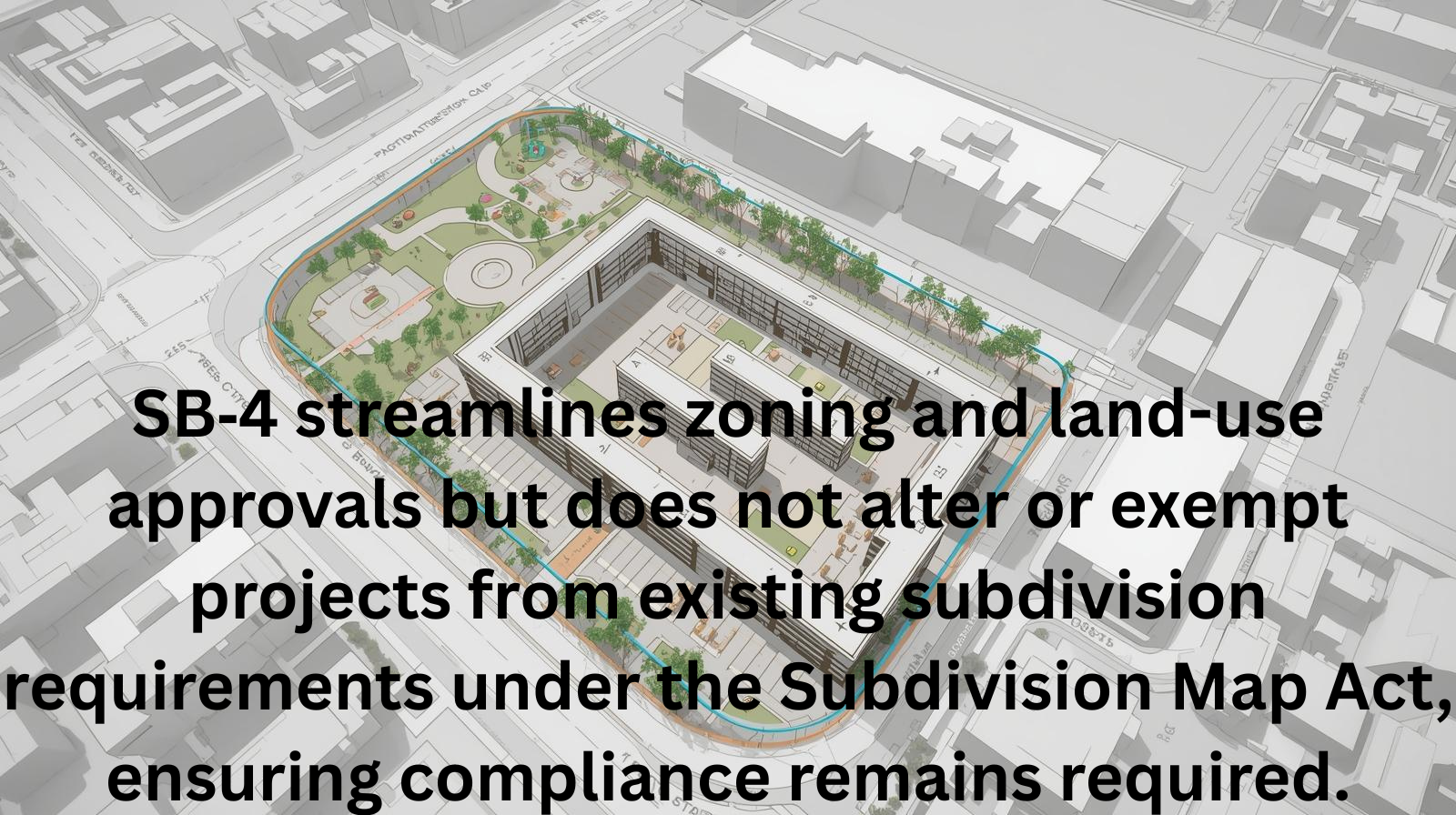
✅ Are SB‑4 Projects Exempt From Filing a Tract Map?
No. SB‑4 does not exempt a church or nonprofit from filing a tract map if the project intends to subdivide land.
Why? — SB‑4 Streamlines Use Approval, Not Parcel Division
SB‑4 guarantees:
- Use‑by‑right approval for qualifying 100% affordable Housing projects
- Streamlined, ministerial approval (no hearings, no CUP, no CEQA challenges)
- Zoning overrides for sites owned by churches or nonprofit colleges
These facts are confirmed in multiple sources:
- SB‑4 “provides a streamlined process… overriding local zoning restrictions” and guarantees by‑right approval when objective standards are met.
- SB‑4 projects receive ministerial approval without discretionary permits or CEQA, providing certainty and predictability for your development process.
- SB‑4 is a use-by-right development statute, not a subdivision statute—no part of SB‑4 references subdivision exemptions or changes to the Subdivision Map Act.
Nowhere in SB‑4 is there:
- a waiver of the Subdivision Map Act,
- an exemption from tentative/parcel maps,
- authorization to create parcels without maps, or
- language superseding Gov. Code § 66410 et seq.
Because the Subdivision Map Act governs all land divisions, and SB‑4 does not amend it, map requirements remain fully intact.
✅ If the SB‑4 project does NOT create new parcels:
No tract or parcel map is required.
Most SB‑4 developments are vertical multifamily affordable buildings on a single existing parcel; thus, no subdivision is involved.
In these cases, cities issue:
- ministerial site plan approvals,
- ministerial building permits,
without any map requirement.
✅ If the SB‑4 project DOES create new parcels:
A tract map or parcel map is still required.
Examples include:
- Creating separate lots for phases
- Condo map (airspace subdivision)
- Townhome lots
- Fee‑simple small‑lot Housing format
- Subdividing church property into multiple legal parcels
Because SB‑4 does not remove subdivision requirements, the project must comply with:
- Tentative map filing
- Final map or parcel map
- Surveying
- Dedications/easements
- Public works/engineering review
All of this occurs ministerially—cities cannot impose discretionary review or hearings.
⚖️ How Cities Must Process Maps Under SB‑4
While a tract/parcel map is required when land is subdivided, SB‑4 requires cities to process any necessary ministerial approvals, similar to the SB‑684 and SB‑9 frameworks.
This means:
- No public hearings
- No CEQA
- No discretionary conditions
- Objective standards only
- No appeals
(consistent with SB‑4’s ministerial mandate and zoning overrides).
Cities must still:
- Check the map for technical compliance,
- Apply public‑works engineering standards,
- Ensure safe access, utilities, dedications, etc.
But may not use the map process to block the project.