Summary
British naval historian C. Northcote Parkinson’s insights-especially that “work expands to fill the time available”-are highly relevant for leaders and managers aiming to improve organizational efficiency. His witty, data-informed critiques—later collected in Parkinson’s Law: The Pursuit of Progress—explain why tasks bloat, budgets balloon, and committees stall. This article distills the core laws, provides real-world examples, introduces the Coefficient of Inefficiency, and offers concrete, leader-ready tactics—plus a visual efficiency curve and comparison chart you can use in boardrooms today.
The Primary Law: Elastic Work
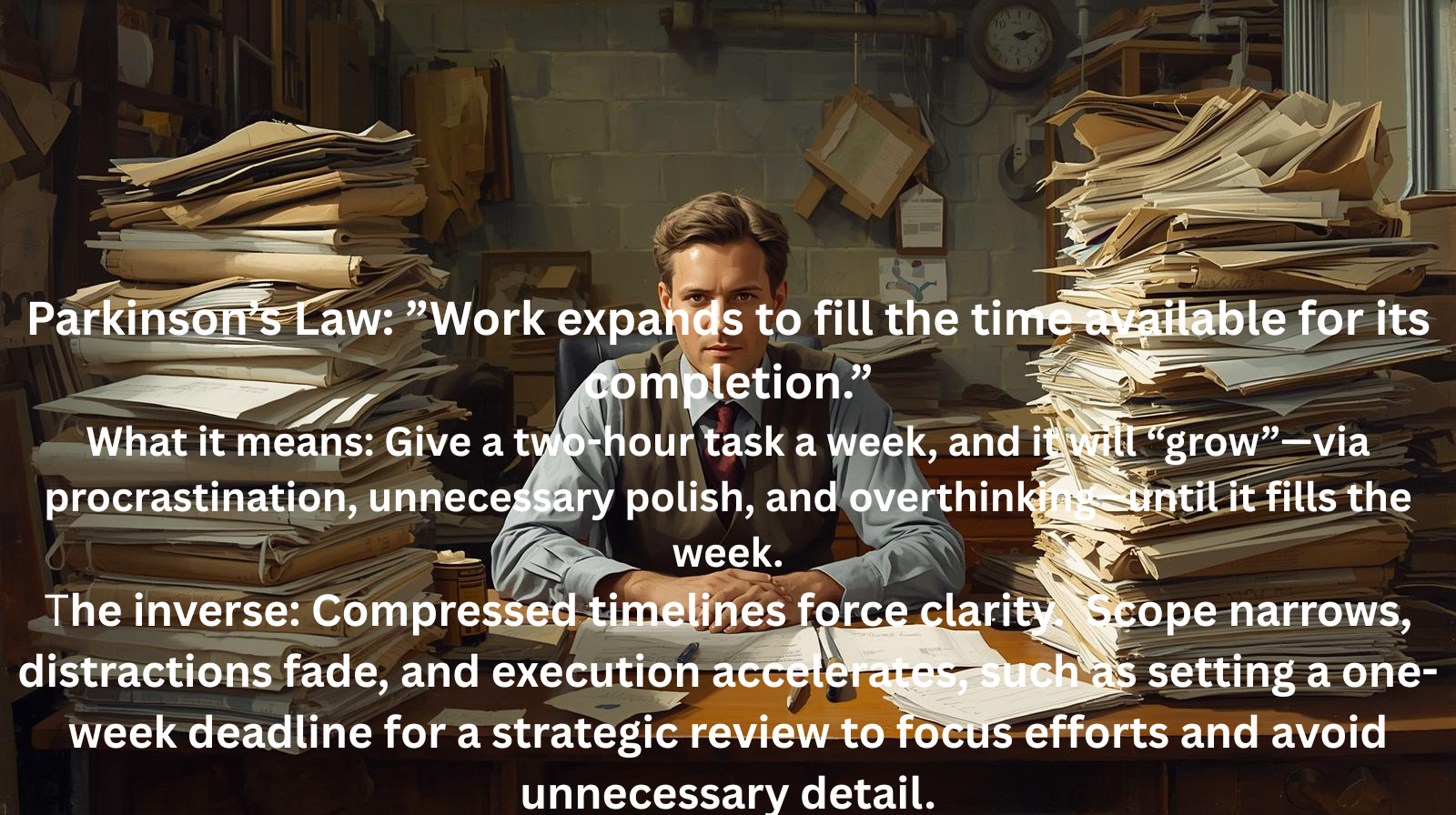
Parkinson’s Law: ” Work expands to fill the time available for its completion.”
- What it means: Give a two-hour task a week, and it will “grow”—via procrastination, unnecessary polish, and overthinking—until it fills the week.
- The inverse: Compressed timelines force clarity. Scope narrows, distractions fade, and execution accelerates, such as setting a one-week deadline for a strategic review to focus efforts and avoid unnecessary detail.
Practical antidotes
- Timeboxing: Assign firm, aggressive windows to tasks and agenda items; stop when time is up.
- Pomodoro cadence: Short bursts (e.g., 25 minutes) with brief breaks sustain intensity and prevent perfectionist drift.
- Pull forward milestones: Aim to complete critical components earlier than the official due date to avoid last-minute delays.
Secondary Laws and Observations
1) Law of Triviality (“Bikeshedding”)
Teams spend disproportionate time on simple, low-stakes topics (like the paint color of a bike shed) because everyone can participate with confidence—while high-stakes, complex issues get short shrift.
Leader move: Gatekeep agenda time for high-impact decisions; assign pre-work for complex items so the meeting can decide, not merely discuss.
2) Parkinson’s Second Law: Expenditures Rise to MeIncomeome
Organizations and individuals tend to spend everything they earn. Budget growth becomes a habit, not a necessity.
Leader move: Use zero-based budgeting cycles; link disbursements to outcomes rather than historical baselines.
3) Bureaucratic Growth
Administrative headcount often grows 5–7% annually, regardless of workload, driven by preferences for subordinates over rivals and by creating Work to justify roles.
Leader move: Cap staff growth unless tied to measurable demand; sunset roles that outlive their mission.
4) Coefficient of Inefficiency
Beyond a specific size—typically ~20 members—committees become manifestly inefficient. Coordination costs explode; accountability diffuses; factions form; decisions stall. (See visual below.)
Real-World Examples of Parkinson’s Laws in Action
- Government agencies: Automation shrinks transactional workload, yet departments add “oversight” roles—result: more reporting, more meetings—little net gain.
-
Corporate meetings: A one-hour slot for a minor update balloons into a full hour; tangents multiply, and decisions drift.
- Software projects: Six months allocated for a two-month feature invites scope creep and ornamental refinements. Hackathons—by contrast—deliver prototypes in 48 hours because time is tight and goals are clear.
- Personal finance: Pay raises trigger lifestyle upgrades—larger homes, newer cars—without increasing savings.
- Data/storage: Expand capacity and watch data sprawl. Redundant files and “just-in-case” backups accumulate simply because space is available.
- Large boards & nonprofits: Boards with more than 20 members face procedural minutiae and defer tough calls. Subgroups proliferate; accountability fragments.
The Coefficient of Inefficiency—Explained
Definition: A decision-making body’s efficiency declines as membership grows, with a clear break point beyond which effectiveness collapses—commonly observed around 19–22 members.
Why it happens
- Coordination overhead: Scheduling, circulating drafts, and reconciling viewpoints consume the clock.
- Diffusion of responsibility: Accountability thins; social loafing rises.
- Fragmentation: Subgroups form; compromise becomes an end rather than a means.
- Dominance & silence: A few voices monopolize airtime while others disengage.
Leader takeaway: Keep core committees lean and use subcommittees for depth, so leaders feel confident and effective in decision-making.
Optimizing Committee Size
Target the “sweet spot.” For most decision-making bodies, 7–12 members strike a balance between diversity and agility.
Design principles
· Purpose before size
o Strategic/Executive: 5–9 for speed and clarity.
o Advisory/Consultative: 10–15 for broader input (paired with clear handoffs to a smaller decision group).
· Avoid the representation trap
o Use rotating seats, liaison roles, and observer status to widen input without bloating membership.
· Depth via subcommittees
o Delegate technical or financial analysis to small task forces; return concise, decision-ready summaries.
· Clarify authority and quorum
o Empower the chair or an executive subgroup for time-critical decisions within pre-set bounds.
· Leverage asynchronous tools
o Collect updates in shared workspaces so meeting time is reserved for decisions, not status readouts.
· Review annually
o Reassess scope, membership, and outcomes every 12–18 months; merge overlaps; sunset committees that have served their purpose.
Rule of thumb
- Under 7: Risk, narrow perspective.
- 7–12: Optimal.
- 13–15: Use caution—coordination costs rise.
- >20: Expect gridlock; split or restructure.
Committee vs Teams
Key Distinction
-
Committees = Oversight and Advice
-
Teams = Action and Delivery
Attribute |
Committee |
Team |
Purpose |
Advisory or governance; oversight and recommendations |
Execution-focused; delivers specific outcomes |
Structure |
Formal, often permanent; appointed members |
Flexible, often temporary; selected for skills |
Decision-Making |
Consensus-driven; follows rules of order |
Collaborative and action-oriented |
Output |
Policies, recommendations, oversight reports |
Tangible deliverables: products, projects |
Duration |
Long-term or standing |
Short-term or project-based |
Example |
Audit Committee, Ethics Committee |
Product Development Team, Marketing Team |
Highlights from the Chart
- Purpose: Committees advise and govern; teams execute and deliver.
- Structure: Committees are formal and often permanent; teams are flexible and skill-based.
- Decision-Making: Committees lean on consensus and formal rules; teams prioritize speed and collaboration.
- Output: Committees produce policies and recommendations; teams produce tangible deliverables.
- Duration: Committees are long-term; teams are typically project-based.
- Examples: Audit Committee vs Product Development Team.
Key Takeaways from Parkinson’s Laws
1. Work expands to fill time
Extended deadlines invite procrastination and perfectionism; tight timelines force focus.
2. Beware bikeshedding
Guard agenda time for high-impact decisions; assign pre-work for complex topics.
3. Spending tracIncomeome
Budget creep is inevitable without controls; use zero-based budgeting and outcome-linked spending.
4. Bureaucracy grows by default
Headcount often rises 5–7% annually regardless of workload; tie growth to demand and sunset redundant roles.
5. Committee size matters
Optimal: 7–12 members. Danger zone: Beyond 20, expect gridlock.
6. Practical fixes
Timebox tasks and meetings; apply the 80/20 rule; use subcommittees for depth; review structures annually.
Quotes from Parkinson
“Work expands to fill the time available for its completion.”
— C. Northcote Parkinson, 1955
“The demand upon a resource tends to expand to match the supply of the resource.”
— C. Northcote Parkinson
Closing Paragraph
Parkinson’s Laws are more than witty observations—they’re warnings. Left unchecked, time, budgets, and committees will expand until progress grinds to a halt. In today’s environment of limitless storage, sprawling calendars, and remote Work, these forces are stronger than ever. Leaders who design efficiency through lean structures, disciplined deadlines, and clear decision rights—don’t just fight bureaucracy; they build organizations where clarity beats complexity and results replace rituals.
The question isn’t whether Parkinson’s Laws apply to you—they do. The question is: Will you act before inefficiency becomes your culture?