Summary
Most of us live on the fly, even if we don’t realize it. We make mid-conversation decisions, solve problems while already moving, and adjust plans in real time because stopping is no longer an option. Few phrases capture this reality as precisely—or as casually—as the idiom on the fly. Short, flexible, and endlessly adaptable, “on the fly” has become the language of speed, improvisation, and modern pressure, inspiring confidence in our ability to adjust quickly.
What “On the Fly” Really Means
At its core, on the fly describes action without pause.
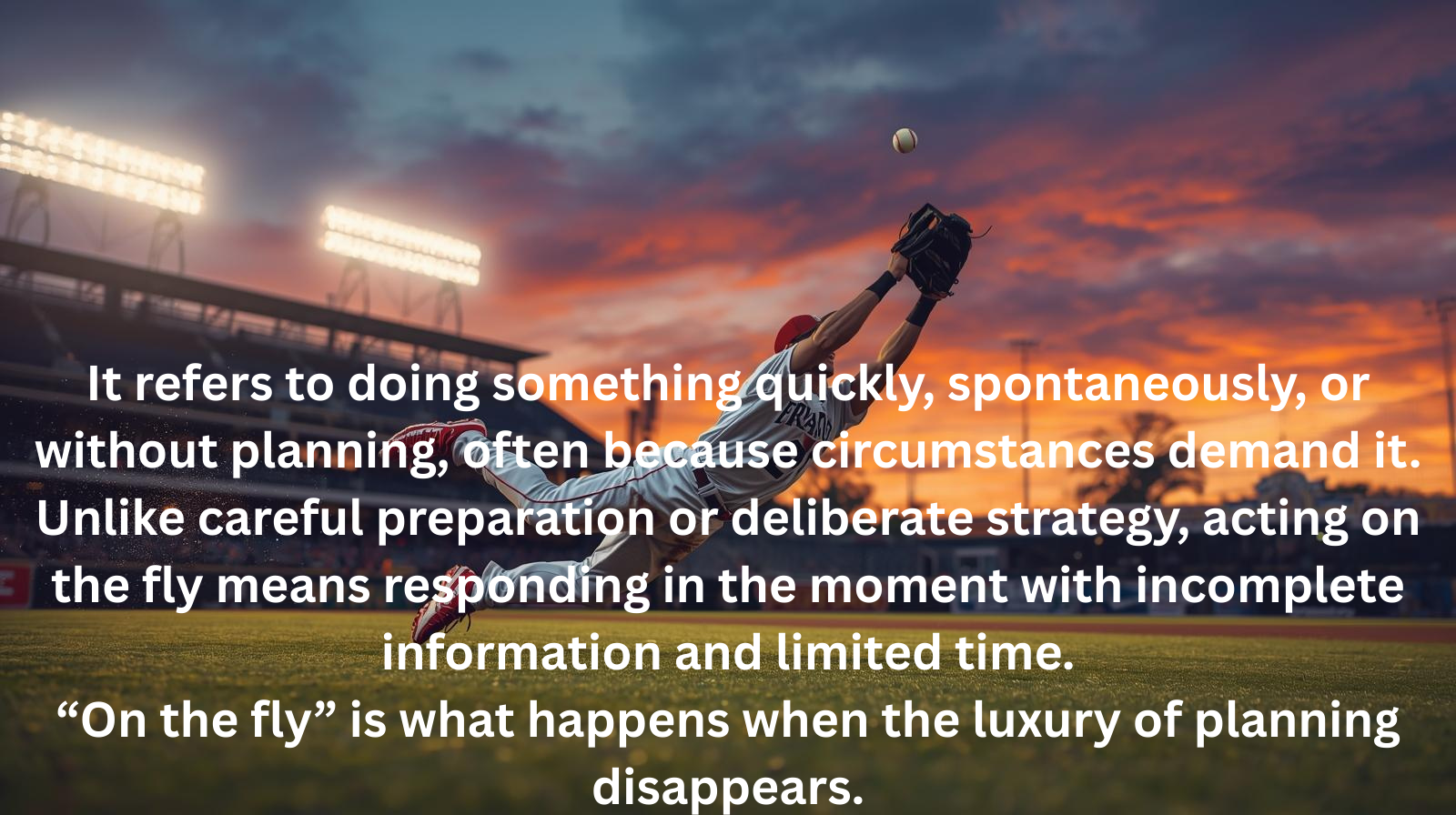
It refers to doing something quickly, spontaneously, or without planning, often because circumstances demand it. Unlike careful preparation or deliberate strategy, acting on the fly means responding in the moment with incomplete information and limited time.
“On the fly” is what happens when the luxury of planning disappears.
The phrase is neutral in tone—it can signal competence and agility, or risk and haste—depending entirely on context.
The Three Core Meanings
Although the phrase feels casual, its usage clusters around three clear ideas.
1. Improvisation Under Pressure
This is the most common meaning. Acting on the fly means handling a situation as it unfolds, often because something unexpected has occurred.
A meeting goes off script.
A project changes direction midstream.
A decision must be made before all the data is available.
In these moments, planning gives way to judgment.
To act on the fly is to trade certainty for speed.
2. Doing Something While in Motion
Sometimes, on the fly is literal. It describes completing a task while moving from one place or state to another.
- Grabbing lunch between appointments
- Returning calls while commuting
- Reviewing documents during travel
Here, the phrase signals efficiency—but also compression. Life no longer pauses to accommodate tasks; tasks are squeezed into motion.
3. Simultaneous Action
In its third sense, on the fly means doing one thing while already engaged in another.
Multitasking may be debated, but the language reflects reality. People adapt, adjust, and solve problems without disengaging from their primary activity.
“On the fly” is not about perfection—it’s about continuity.
The phrase takes on a sharper, more precise meaning in professional settings, where improvisation can have serious consequences, emphasizing the need for accuracy under pressure.
The phrase takes on a sharper definition in professional settings, where improvisation can carry real consequences.
Computing and Technology
In technology, on the fly means making changes without stopping a system.
- Hot-swapping hardware
- Modifying live code
- Processing data without a reboot
These actions demand precision because mistakes occur in real time, often under load.
In computing, “on the fly” is a promise: change without disruption.
Restaurants and Hospitality
In kitchens, on the fly is not a suggestion—it’s a command.
A dish must be remade immediately.
A guest is in a hurry.
An error needs to be corrected before it reaches the table.
Speed matters, but so does quality. There is no rewind.
“On the fly” in a kitchen means urgency without excuse.
Sports: Ice Hockey
In ice hockey, players substitute while Play continues, hopping over the boards without a whistle or stoppage.
Timing, awareness, and coordination are critical. A missed step can cost a goal.
Here, on the fly, is literal, kinetic, and unforgiving.
Automotive and Mechanical Systems
In automotive contexts, the phrase describes adjustments made while a vehicle is in motion.
- Switching from 2WD to 4WD
- Adjusting traction or drive modes
These features reflect modern expectations: systems must adapt without stopping progress.
Despite its modern feel, “on the fly” has surprisingly old roots, originating in American baseball in the mid-1800s, which can foster appreciation for its enduring relevance.
Despite its modern feel, on the fly has surprisingly old origins.
The phrase likely emerged from American baseball in the mid‑1800s, where catching a fly ball—one hit high into the air—required quick reaction and decisive movement before the ball touched the ground.
To catch a ball “on the fly” meant acting instantly, without a second chance.
From baseball fields to boardrooms, the meaning never changed: act now or miss it.
Over time, the phrase left sports and entered everyday speech, retaining its emphasis on speed and immediacy.
Why the Phrase Endures
Language survives because it stays useful.
On the fly has endured because it describes a condition that has only intensified: the shrinking gap between decision and action.
- Information moves faster
- Expectations rise
- Delays carry higher costs
Planning still matters—but adaptability now competes with preparation as a core skill.
Modern life doesn’t reward perfect plans. It rewards fast recovery.
The Double Edge of Acting “On the Fly”
The phrase carries both praise and warning, highlighting agility and responsiveness, as well as risk and mistakes, encouraging a realistic view of its application.
The Upside
- Agility
- Responsiveness
- Practical intelligence
The Downside
- Increased risk
- Incomplete information
- Mistakes made under pressure
Whether on-the-fly signals competence or chaos depends on experience, not speed alone.
Why We Use It So Casually
Perhaps the most telling thing about on the fly is how casually we say it.
The phrase normalizes urgency. It suggests that adapting midstream is not exceptional—it’s expected.
What once described emergencies now describes a Tuesday.
In that sense, on the fly is not just an idiom. It is a quiet admission about how we live and work now.
Final Thought
On the fly began as a simple description of catching a ball in midair. Still, today it encapsulates how we manage projects, meals, technology, and careers, showing its evolution from sports to everyday life.
It survives because it is honest.
We plan when we can. We improvise when we must. And increasingly, we do both at the same time—on the fly.
✅ Quotes