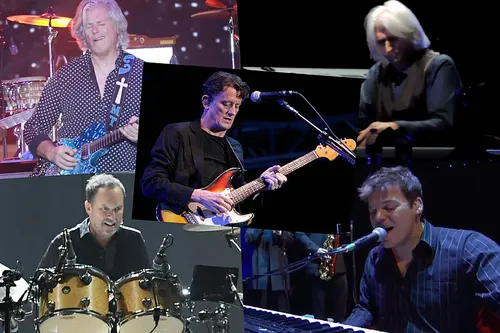
Summary
Released as the third single from Hotel California and peaking at No. 11 on the Billboard Hot 100, it’s one of those rare hits that became a cultural phrase—often celebrated for its adrenaline while prompting listeners to consider its critique of excess —underscoring its enduring influence on popular culture and inspiring ongoing reflection.
Videos
https://www.youtube.com/watch?v=Afw8fXELRl8
https://www.youtube.com/watch?v=PhC7Gh84CdY
https://www.youtube.com/watch?v=1TMykV8cLCk
1) Where it sits in the Hotel California universe
To understand the song’s punch, start with its neighborhood: Hotel California—recorded between March and October 1976 at Criteria (Miami) and Record Plant (Los Angeles) with producer Bill Szymczyk—was the Eagles leaning into darker themes and a harder rock edge.
The album was also a band “hinge moment”: it was their first with Joe Walsh (new chemistry, new aggression) and among the last with Randy Meisner, so the tension between polish and volatility is baked into the record’s DNA.
“On Hotel California, the Eagles didn’t abandon the California dream—they flipped it over and showed the price tag.”
2) The riff that became the song (and why that matters)
Unlike many classic rock staples that begin with lyrics or chord progressions, “Life in the Fast Lane” started as a guitar figure Walsh used to warm up, which explains its relentless forward motion. Walsh has described it as a pre-show circuit‑builder—something he’d Play repeatedly to get his hands and timing locked in—until Henley and Frey heard the lick and recognized a song hiding inside it. This origin directly influences the song’s theme of velocity and danger, as the riff serves as the track’s engine, symbolizing the unstoppable momentum of reckless living and the risks it entails.
That origin matters because it explains the track’s relentless forward motion: the riff isn’t decoration; it’s the engine block: everything else—groove, melody, narrative—bolts onto that piece of momentum.
“Some songs start with a message. This one starts with horsepower.”
3) Title as trigger: “The Count” and the freeway moment
The title didn’t come from a brainstorming session—it arrived like a story you overhear in traffic. Multiple accounts trace the phrase to Glenn Frey riding with a drug dealer nicknamed “The Count,” who, when asked to slow down on the freeway, shrugged it off with the now-famous phrase.
That anecdote does more than provide trivia; it anchors the song’s tone. The phrase “life in the fast lane” isn’t poetic—it’s casual, flippant, effortless, the kind of line someone drops right before consequences enter the scene.
“The best song titles feel inevitable—like they existed before the song did.”
4) Storytelling without a sermon: how the lyrics work
Even without quoting lyrics, the narrative is straightforward: a glamorous couple moves through status, temptation, and appetite with zero friction—until the bill arrives. Wikipedia’s summary captures the core arc as a couple taking an excessive lifestyle to the edge, and contemporary commentary often emphasizes that the track is not meant to glamorize so much as depict a spiral.
American Songwriter’s “Behind the Song” framing highlights how the band used vivid character sketching and scene changes—nightlife, substances, speed, disorientation—to show the lifestyle’s internal emptiness even when it appears externally “successful.”
“It’s not a morality Play—it’s a mirror. If you see glamour, that’s on you.”
5) The sound: harder Eagles, funkier Eagles, tighter Eagles
Critics at the time noticed the shift. The song has long been identified as one of the Eagles’ more hard-edged rockers, dominated by Walsh’s signature guitar line and a more aggressive band feel than their earlier country-rock sheen.
You can also hear why this track belongs specifically to Hotel California: Szymczyk’s production era with the band emphasized clarity, punch, and separation, allowing the guitars to bite while the rhythm section stays locked—ideal for a song whose concept is velocity.
“The Eagles didn’t just go ‘harder’—they went sharper.”
The studio discipline-versus-chaos dynamic played a role in shaping the song’s intensity. Producer Bill Szymczyk’s approach, imposing strict work hours and control, mirrors the song’s message about the dangers of excess and losing control, making the recording process a real-world reflection of its themes of restraint versus chaos, and how the band navigated their internal tensions during the creation of Hotel California.
Why include this in a “Life in the Fast Lane” analysis? Because it’s the perfect real-world counterpoint to the song’s narrative: the band was trying to craft control inside a culture of excess, producing a track that dramatizes exactly what they were working to avoid.
“It’s a warning written in the language of adrenaline.”
One-sentence thesis
The song’s symbolism turns speed into a moral environment: every image—mirrors, lines, stop signs, engines—shows how a life organized around appetite eventually converts excitement into damage and freedom into captivity.