Summary
My article discusses how platforms capture revenue, algorithms capture audiences, and AI may capture the last clicks.
An industry-wide pattern shows that layoffs aren’t just a surprise—they reflect a deeper, systemic failure to adapt, which should concern all of us.
Legacy media is collapsing because it was distrusted, disarmed, disintermediated, and devalued by an information economy that no longer pays for reporting. The public didn’t stop needing journalism. We built systems that profit from attention while treating journalism as optional input.
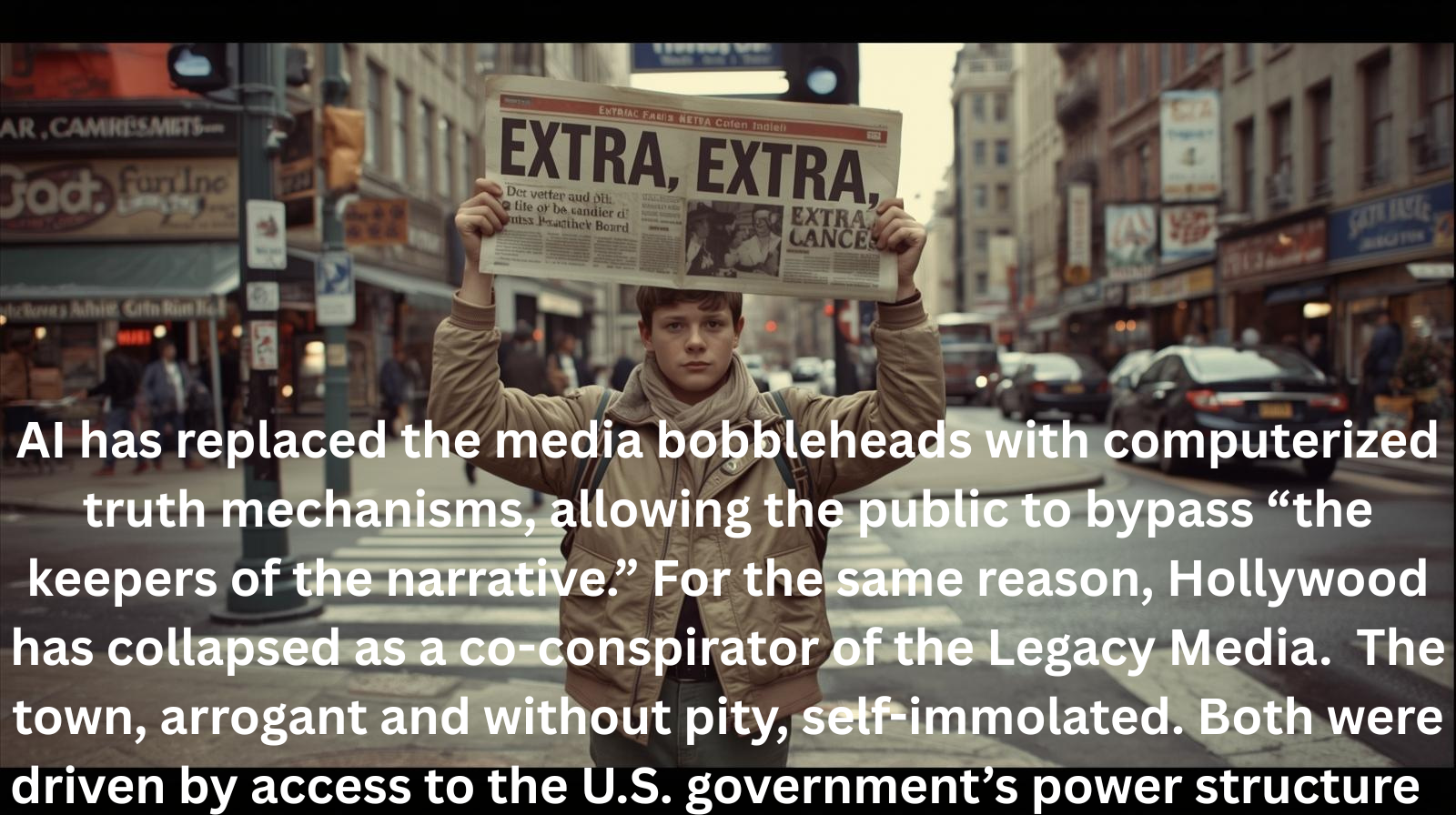
AI has replaced the media bobbleheads with computerized truth mechanisms, allowing the public to bypass “the keepers of the narrative.” For the same reason, Hollywood has collapsed as a co-conspirator of the Legacy Media. The town, arrogant and without pity, self-immolated. Both were driven by access to the U.S. government’s power structure. They served as a megaphone for the establishment, the administrative state, the NGOs, and the Institutions, all powerful, bureaucratically run organizations.
The Big Con: “Just Go Digital”
For two decades, publishers were told a simple story: move online, and the market will sort itself out. But “online” didn’t become a fairer marketplace; it became an extraction economy—one where the most valuable functions (distribution, targeting, measurement, and monetization) migrated to platforms that have no obligation to fund newsrooms.
Yes, audiences shifted. But the deeper shift was financial: digital advertising scaled to extraordinary heights, while the share that reaches reporting organizations remains thin compared to the cost of producing original work. The IAB/PwC Internet Advertising Revenue Report illustrates just how enormous the internet ad market is—proof that advertising didn’t “disappear,” it concentrated.
Scarcity Paid the Bills. Abundance Broke the Model.
Legacy media was built for scarcity: limited channels and predictable demand. The internet replaced scarcity with abundance, disrupting the entire model.
You can see the erosion in long-run trends. Pew’s newspaper data shows continued circulation decline and a weakening base that once made local reporting economically rational. This isn’t nostalgia; it’s the loss of the audience “floor” that used to underwrite the whole enterprise.
The Platform Landlord Problem
The industry’s fatal mistake wasn’t just missing digital; it was building distribution on rented land, making publishers vulnerable to platform shifts.
When social platforms were generous with referral traffic, publishers mistook it for permanence. It never was. Platforms are not public utilities; they are private attention machines that optimize for what keeps users inside the app. When “news” stopped serving that goal, it was demoted.
Meta’s move to end the Facebook News tab in the U.S. and Australia—and to stop entering new deals designed for news publishers—was a clarifying moment: news is not a strategic priority for one of the world’s largest distributors of content.
And When the Tap Tightens, Newsrooms Bleed
This isn’t theoretical. When platform emphasis changes, referrals can drop—sometimes sharply—because publishers don’t control the pipes. That volatility is a business risk, not a content critique. It’s what happens when the algorithm becomes your circulation department.
Even analyses tracking the News tab shutdown period showed measurable declines in Facebook referral traffic in some markets—small percentages in aggregate, but painful for outlets whose margins already resemble a tightrope. “Rely less on platforms” is good advice, but it arrives after a decade of incentives built around doing the opposite.
Local News Didn’t “Fail.” It Was Outbid.
If the decline of local news is due to systemic issues, it should alarm us all, as it threatens the fabric of community life and informed citizenship.
Northwestern’s Medill Local News Initiative tracks the spread of “news deserts”—counties with no meaningful local reporting—and the steady pace of closures. In 2025, Medill reported 213 news-desert counties and roughly 50 million Americans living with limited or no access to local news (counties with zero or only one local source).
The Doom Loop: Cut the News, Lose the Audience, Cut Again
As revenue shrinks, owners cut staff—coverage thins. Distinctiveness declines. Trust and habit weaken. Then revenue shrinks again. It’s not a reinvention cycle—it’s a hollowing-out cycle.
By the time a newsroom is “optimized,” the product may no longer be strong enough to justify payment—especially in local markets where the audience is smaller, and the ad base has been siphoned away. What survives is often a brand name with a skeleton staff, reporting fewer stories, with less time to dig.
Trust, Fatigue, Avoidance: The Demand Side Is Cracking Too
Here’s the second squeeze: even if publishers could rebuild revenue, they face a public increasingly overwhelmed by the news cycle, suspicious of institutions, and pulled toward alternative voices and video-first platforms—Reuters Institute research documents declining engagement with traditional sources and rising reliance on social and video networks.
The more the ecosystem fragments, the harder it becomes for “institutional journalism” to maintain the kind of daily relationship that supports subscriptions and habitual readership. Reuters’ reporting on low trust, news avoidance, and stagnating digital subscriptions underscores that this is not a simple “paywall solves it” era.
Subscriptions Help—But “Subscription Fatigue” Is the New Ceiling
Reader revenue is the rational response to ad disruption. But it’s not a universal bailout. National brands with unique value can build strong subscriber businesses; many local outlets can’t. And in a crowded monthly-bill environment, consumers make ruthless choices.
Broader subscription-market research indicates rising cancellation behavior and “fatigue” among households as they manage costs and perceived value. Again: not identical to news—but the consumer logic is the same. If the pitch isn’t unmistakable, the subscription is expendable.
Policy Isn’t “Saving Legacy Media.” It’s Admitting Market Failure.
Recognizing that market forces fail to support public-interest journalism should motivate policymakers and citizens to advocate for systemic solutions that serve the public good.
Australia’s evolving approach—using incentives or charges to encourage platform deals—arose specifically as Meta signaled it would stop renewing agreements supporting news publishers. Whether these efforts succeed is an open question, but their existence is a confession: the invisible hand isn’t paying for accountability reporting.
Now AI Arrives: The Clickless Future
Just as publishers learned to survive platform volatility, AI began changing discovery again—this time by turning search into answers instead of links. The Reuters Institute’s 2025 report flags publishers’ fear that AI summaries and chatbots could further reduce traffic to news sites.
And reporting has described how AI-powered search summaries can cut referrals by satisfying the query without sending the reader onward—an existential threat to the traffic-and-ads model that still supports much of the web’s content economy.
Search used to reward the best link. AI search rewards the best answer—and keeps the reader where the monetization is.
So What’s Really Collapsing?
Not the human need for trustworthy information. What’s collapsing is the 20th-century funding mechanism for producing it—because the 21st-century attention economy doesn’t pay for the inputs it depends on.
If you want one sentence to carry into the next argument at a dinner table, use this:
Legacy media is collapsing because we built an internet that monetizes attention at scale while treating journalism as a free raw material.
A closing challenge
Here’s the uncomfortable question:
If the systems that control distribution and monetization no longer fund reporting, who will fund it? Platforms won’t do it voluntarily when news is “less than 3%” of what users see; markets won’t do it when ads pay better next to entertainment; and communities can’t do it alone when local revenue has been drained.
The collapse of legacy media is not a morality Play about relevance. It’s a design flaw—an economic architecture that turned reporting into a cost center and left democratic accountability without a sponsor.