Summary
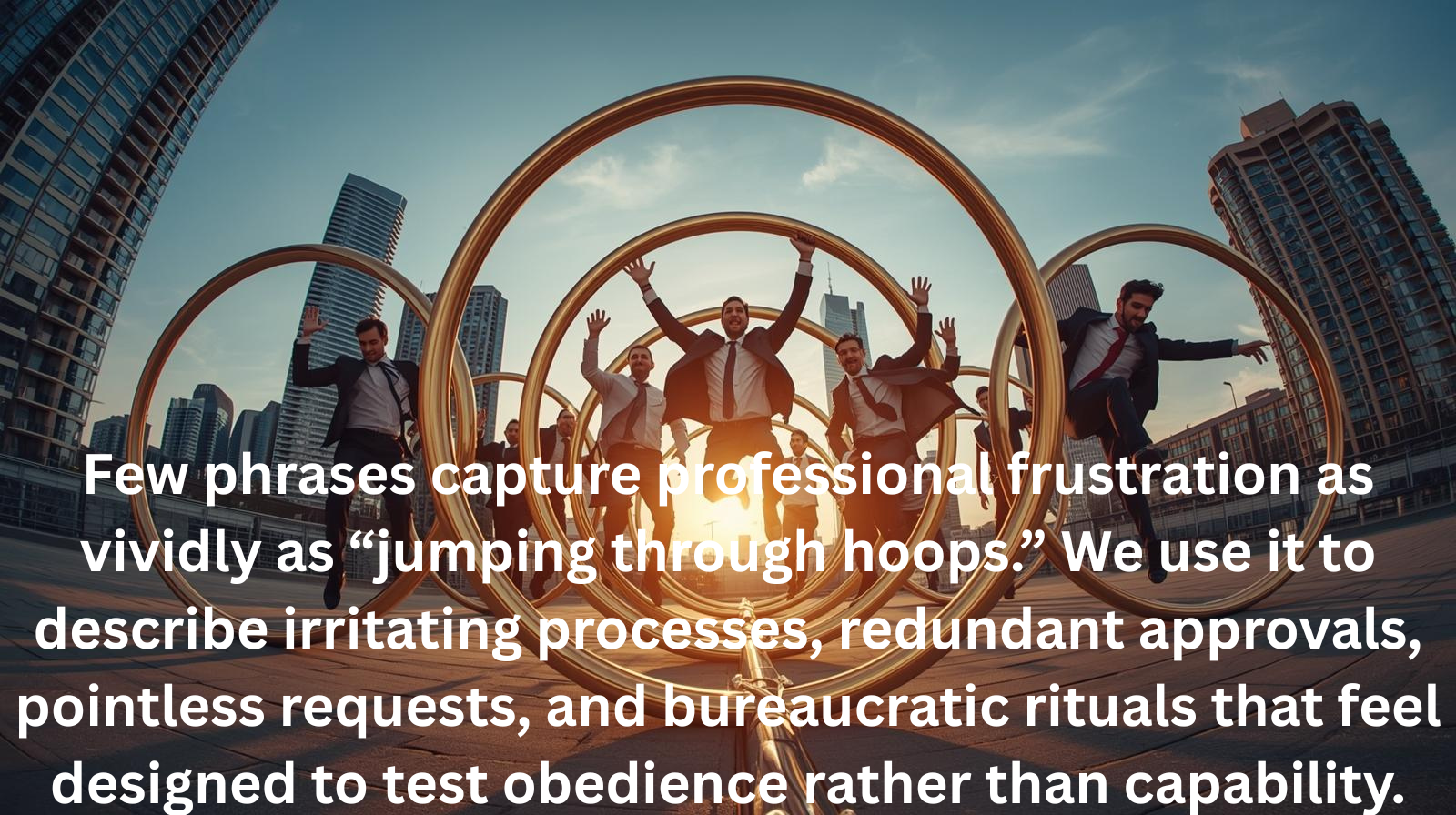
Few phrases capture professional frustration as vividly as “jumping through hoops.” We use it to describe irritating processes, redundant approvals, pointless requests, and bureaucratic rituals that feel designed to test obedience rather than capability. The metaphor dates to 19th-century circuses, where animals leapt through hoops—sometimes flaming—to entertain spectators. Today, the hoops remain, but the performers have changed. Employees, borrowers, and developers now serve as the acrobats, navigating systems that seem to grow more complex every year.
In business, hoops are no longer physical; they are procedural. And they’re everywhere.
🟦 The Nature of Hoops
“Hoops don’t measure value — they measure obedience.”
“People don’t resent hard work. They resent meaningless work.”
Understanding which hoops are necessary versus unnecessary can help professionals feel more confident in navigating bureaucracy and challenge inefficiencies.
Mastering the maze of bureaucratic hoops can inspire professionals to feel more in control and resilient in complex environments.
Originally, jumping through hoops symbolized submission, control, and performance. Audiences admired the spectacle. Trainers admired the compliance.
Modern organizations operate the same way.
Not intentionally, of course—but structurally.
Companies, lenders, agencies, and boards create hoops to:
- Show thoroughness
- Reduce perceived risk
- Standardized processes
- Protect against liability
- Maintain hierarchy
The problem arises when the ritual outlives its purpose, leaving only friction.
That’s when people feel like circus acts instead of professionals.
Why Hoops Multiply in Modern Business
1. Bureaucratic Expansion
Every new rule, department, or compliance memo triggers additional steps that rarely disappear, increasing the burden on professionals and making processes more cumbersome over time.
2. Risk Avoidance
When mistakes are punished more harshly than inefficiencies, organizations pad their processes.
3. Technology Layering
New software rarely replaces old systems—it stacks on top of them.
4. Multiple Stakeholders
Each group adds its own requirements, reviews, and approvals.
By recognizing and reducing unnecessary hoops, professionals can feel more empowered and acknowledged in their efforts to improve processes.
🟧 Business Culture Hoops
“In some organizations, the hoops have hoops.”
“Compliance is rewarded more than competence.”
“The real work begins after the meetings end — and the meetings never end.”
When Hoops Become Habit: Everyday Business Examples
The Meeting Loop
A simple decision—like changing website text—requires:
- A brand review
- A legal review
- A risk assessment
- A stakeholder meeting
- A follow-up meeting to discuss the meeting
Hoop: Meetings substituting for decisions.
The Expense Reimbursement Saga
A $19 purchase requires:
- A scanned receipt
- A coding form
- A supervisor’s approval
- An upload to accounting software
- A second-level approval
Hoop: Controls that cost more than the expense itself.
The Procurement Gauntlet
A small vendor selling software must complete:
- Cybersecurity audits
- Insurance certifications
- ESG and DEI Impact disclosures
- Six-month trial phases
Hoop: Procurement systems designed for Fortune 100s applied to startups.
Hoops in the Mortgage Industry: Where the Metaphor Feels Invented
Mortgage lending is the perfect environment for hoops:
-
Regulation
- Liability
- Secondary market demands
- Documentation
- Risk layering
Together, they create an obstacle course disguised as a loan file.
🟩 Mortgage Hoops
“Mortgage underwriting doesn’t test creditworthiness — it tests patience.”
“The most common mortgage condition is the ‘condition to clear the last condition.’”
“Everyone in the mortgage ecosystem jumps through hoops — just different ones.”
Real‑Life Mortgage Hoops
1. The “One More Document” Spiral
A Borrower submits tax returns, W‑2s, bank statements, and paystubs.
Underwriting responds with:
- A letter explaining a $42 Venmo deposit
- A new paystub because the old one is 31 days old
- Employment verification within 48 hours of closing
Hoop: Tasks that do not improve the lender’s risk assessment.
2. Appraisal Pinball
A completed appraisal goes through automated review systems that flag irrelevant discrepancies.
It bounces between:
- Appraiser
- AMC
- Lender reviewer
- Investor reviewer
Hoop: Overlays and revision loops detached from property reality.
3. Credit Inquiry Letters
Even logical, same-day credit shopping triggers:
- Inquiry explanations
- Proof of no new debt
- Updated credit reports
Hoop: Proving something didn’t happen.
4. Mid-Process Guideline Changes
A broker locks a loan.
Two days later, investor overlays shift.
Underwriting now applies new rules retroactively.
Hoop: Moving goalposts.
Hoops in Land Development: Bureaucracy with a Capital “B”
If mortgages are a gauntlet, land development is an obstacle course stacked on a minefield wrapped in a maze.
Developers navigate hoops in three separate dimensions:
- Regulatory
- Environmental
- Political
All of them are costly.
All of them are slow.
🟥 Land Development Hoops
“A developer’s first project isn’t a building — it’s the paperwork to build the building.”
“When five agencies review one plan, expect five different answers.”
“CEQA doesn’t kill projects — process fatigue does.”
Real‑Life Land Development Hoops
1. The Five‑Agency Site Review
A small infill project must satisfy:
- Planning
- Engineering
- Fire
- Traffic
- Environmental
Each sends conflicting comments, often weeks apart.
Hoop: Agencies that do not coordinate.
2. The Biological Survey Time Bomb
A biological study completed in March is rejected:
- Nesting season began
- The survey must be redone
- Six-month delay
- Tens of thousands more in consulting fees
Hoop: Environmental cycles misaligned with project schedules.
3. CEQA Ping‑Pong
A developer produces a 600-page CEQA report.
A neighborhood group files boilerplate objections requiring point-by-point responses—regardless of merit.
Hoop: Mandatory response cycles designed to exhaust.
4. Conflicting Utility Requirements
The water district, fire marshal, and engineering department demand three different utility configurations.
Hoop: Jurisdictional overlap with no arbiter.
Why Hoops Persist: The Psychology of Bureaucracy
Hoops survive because they serve psychological and organizational functions:
- They create an illusion of control.
- They diffuse responsibility.
- They justify job roles.
- They prevent risk—sometimes more than they enable results.
People don’t set out to create hoops.
Hoops emerge when systems become more important than outcomes.
Reframing Hoops: Filters vs. Obstacles
Not all hoops are bad.
Filter Hoops
Necessary, meaningful, and protective:
- Prevent fraud
- Ensure quality
- Protect public safety
- Reduce systemic risk
Obstacle Hoops
Redundant, purposeless, or political:
- Delay projects
- Inflate costs
- Exhaust participants
- Reward compliance over competence
The goal isn’t eliminating hoops—it’s eliminating the wrong ones.
Conclusion: Navigating a World of Hoops
“Jumping through hoops” is more than a complaint.
It’s a description of how work is structured in modern society.
Hoops exist in:
- Corporations
- Government
- Mortgage lending
- Development
- Nonprofits
- Academia