Causal chain:
· Intrusive Policies Increase Compliance Costs
Businesses and individuals face mounting paperwork, fees, and legal exposure.
· Perceived Exploitation Reduces Trust
People view the formal economy as unfair and burdensome, eroding confidence in institutions.
· Rational Choice to Exit the System
When the cost of compliance outweighs the benefits, actors choose informal alternatives—such as cash jobs, unreported income, and off-the-books transactions.
· Growth of the Underground Economy
Informality expands, reducing tax revenue and distorting economic data.
· Government Responds with More Enforcement
To recover lost revenue, authorities impose stricter rules and penalties—further increasing compliance costs.
· Cycle Reinforces Itself
Each new layer of regulation drives more people underground, creating a self-perpetuating feedback loop.
Enforcement often worsens the feedback loop by amplifying the very conditions, such as increased compliance costs and distrust, that drive stakeholders to operate informally, highlighting the need for nuanced policy responses.
Here’s how:
1. Increased Enforcement Raises Compliance Costs
When governments respond to informality with stricter audits, higher penalties, and more inspections, the cost of staying legal rises even further. Small businesses and individuals already struggling with complex regulations see compliance as unattainable.
2. Fear and Distrust Escalate
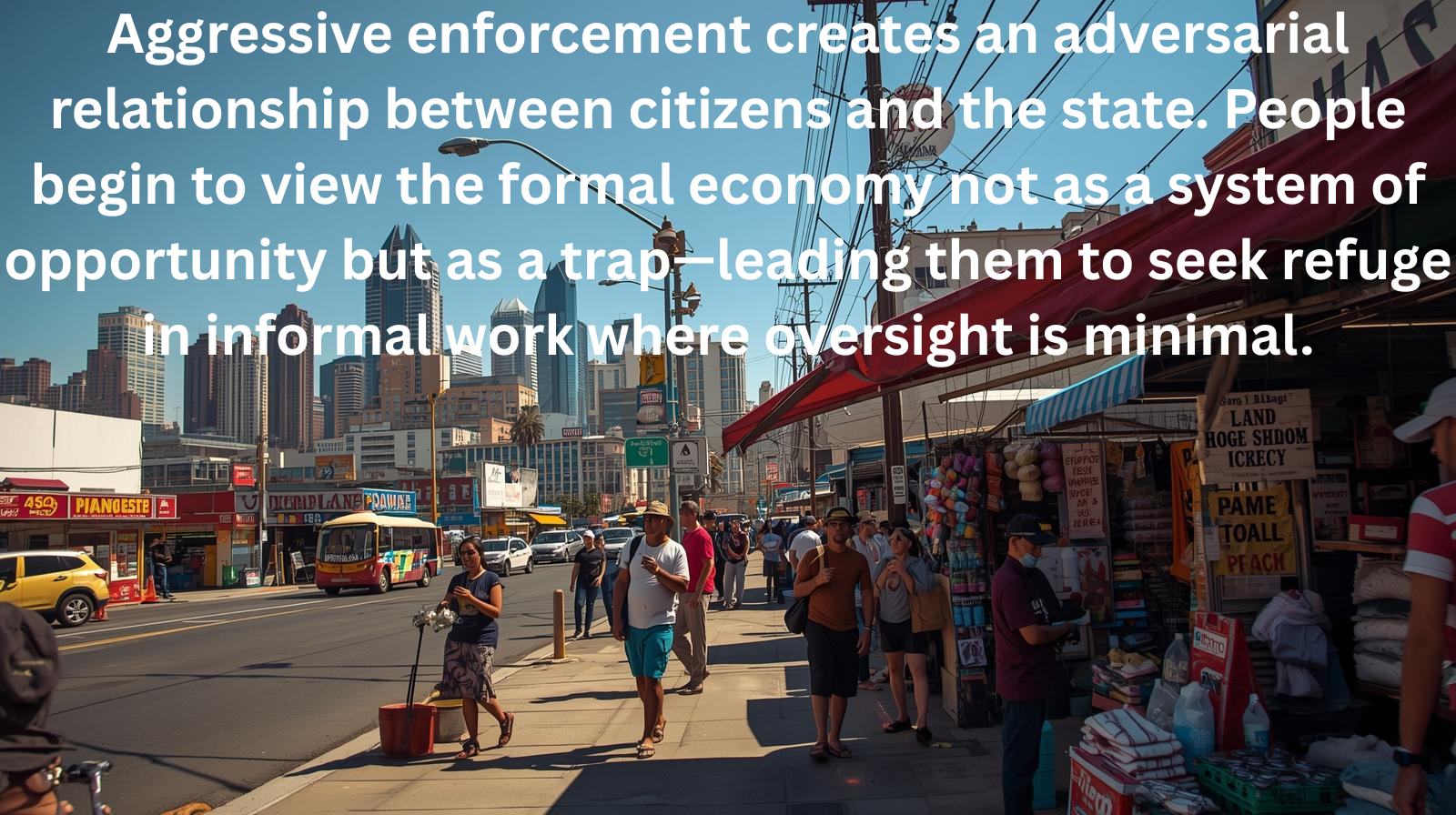
Aggressive enforcement creates an adversarial relationship between citizens and the state. People begin to view the formal economy not as a system of opportunity but as a trap—leading them to seek refuge in informal work where oversight is minimal.
3. Push Toward Greater Secrecy
As enforcement intensifies, underground actors become more sophisticated in hiding transactions—using cash, encrypted platforms, and informal networks. This makes detection harder and deepens the shadow economy.
4. Shrinking Formal Participation
Instead of encouraging compliance, punitive measures often drive borderline participants (those who might have formalized) deeper into informality. The result: fewer tax-paying businesses, more unreported income, and a growing tax gap.
5. Self-Reinforcing Cycle
- Step 1: The Government tightens enforcement to recover lost revenue.
- Step 2: Compliance costs rise, pushing more people underground.
- Step 3: The Underground economy expands, further reducing revenue.
- Step 4: Government responds with even stricter enforcement.
- Recognizing the self-reinforcing nature of this cycle underscores the importance of exploring alternative policies, such as reducing compliance costs or improving trust, to address informality and prevent escalation effectively.
Real-world examples of enforcement measures, such as IRS crackdowns on cash businesses and city permit enforcement, illustrate how specific entities reinforce the feedback loop and drive more people into the underground economy.
1. IRS Crackdowns on Cash Businesses
- The IRS has increased audits on small businesses suspected of underreporting cash income, such as restaurants and contractors.
- While intended to recover lost tax revenue, these audits often push borderline businesses further underground to avoid future scrutiny.
2. Licensing and Permit Enforcement
- Cities like Los Angeles have strict permit requirements for street vendors. Enforcement sweeps confiscating goods and issuing fines, making compliance costly.
- Many vendors respond by operating in more hidden locations or at night, deepening informality.
3. Wage and Labor Law Enforcement
- States like California impose heavy penalties for misclassification of workers (e.g., gig workers as independent contractors).
- Instead of formalizing, some businesses shift to cash payments and informal hiring to avoid litigation risk.
4. Immigration Enforcement
- Crackdowns on undocumented workers in agriculture and construction have led employers to pay workers off the books to avoid detection.
- This creates a shadow labor market with zero protection.
5. Zoning and Regulatory Enforcement
- Home-based businesses face fines for operating without proper zoning or permits.
- Many entrepreneurs choose to remain informal rather than navigate complex compliance systems.
6. Increased Penalties for Non-Compliance
- States have raised fines for late tax filings and licensing violations.
- For low-margin businesses, these penalties make formal participation financially irrational.
Impact
These enforcement actions often fail to reduce informality.
Instead, they:
- Increase fear and distrust of government.
- Raise compliance costs beyond reach for small operators.
- Push economic activity deeper underground, making it harder to monitor and regulate.
Enforcement and overregulation have a unique Impact on gig economy workers, and it often worsens the feedback loop:
1. Classification Battles
- States like California (AB5 Law) require gig workers to be classified as employees rather than independent contractors.
- While intended to provide benefits, this raises costs for platforms and reduces workers’ flexibility.
- Many gig workers respond by moving to cash-based side hustles or informal jobs to retain autonomy.
2. Increased Compliance Burden
- Gig platforms must comply with labor laws, tax reporting, and insurance mandates.
- Some companies exit markets (e.g., rideshare firms threatening to leave California), reducing formal gig opportunities.
- Workers then turn to unregulated alternatives, such as informal ridesharing or home services.
3. Tax Enforcement
- IRS requires gig platforms to report earnings via 1099-K forms, even for small amounts.
- This discourages some workers from using platforms and pushes them toward cash-only arrangements to avoid taxes.
4. Loss of Flexibility
- Enforcement aimed at “protecting” gig workers often removes the very flexibility they value.
- When formal gig work becomes rigid and costly, workers turn to informal channels to preserve autonomy.
5. Feedback Loop Effect
- More regulation → fewer formal gig opportunities → rise in informal gigs → reduced tax revenue → more enforcement.
- This cycle mirrors the broader dynamics of the underground economy.
California’s AB5 Law and its consequences:
What Is AB5?
Assembly Bill 5 (AB5), passed in 2019 and effective January 2020, fundamentally changed how workers are classified in California. It codified the ABC Test, which presumes a worker is an employee unless all three conditions are met:
· A: The worker is free from the control and direction of the hiring entity in performing the work.
· B: The work performed is outside the usual course of the hiring entity’s business.
· C: The worker is engaged in an independently established trade or business of the exact nature as the work performed.
If any of these conditions fail, the worker must be classified as an employee, not an independent contractor.
Why Was AB5 Introduced?
- To prevent misclassification, which allowed companies to avoid paying minimum wage, overtime, payroll taxes, workers’ compensation, and unemployment insurance.
- Misclassification was costing California an estimated $7 billion in unpaid taxes annually.
Who Is Affected?
- Gig workers: Rideshare drivers (Uber, Lyft), delivery drivers (DoorDash), and app-based service providers.
- Freelancers: Writers, photographers, and other independent contractors.
- Small businesses: Those relying on flexible, contract-based labor.
Consequences for Workers
Positive:
- Access to minimum wage, overtime pay, sick leave, unemployment insurance, and workers’ compensation.
- Reimbursement for job-related expenses.
Negative:
- Reduced flexibility for workers who value independence.
- Some companies cut opportunities or exited California markets to avoid compliance.
Consequences for Businesses
- Higher costs: Payroll taxes, benefits, and compliance expenses.
- Operational changes: Companies had to restructure business models or seek exemptions.
- Legal battles: Uber, Lyft, and others fought AB5, leading to Proposition 22, which exempted app-based rideshare and delivery companies but offered limited benefits, such as health stipends.
Broader Impact
- AB5 sparked nationwide debates about gig work and labor rights.
- It highlighted the tension between worker protection and workplace flexibility.
- Enforcement of AB5 pushed some gig workers into informal, cash-based arrangements, reinforcing the underground economy dynamic.