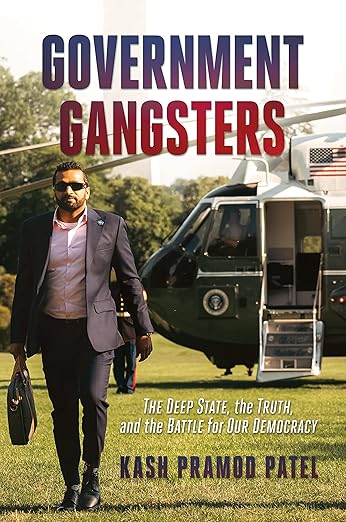
Summary
Kashyap Pramod Patel[a] (born 25 February 1980) is an American lawyer serving since 2025 as the director of the Federal Bureau of Investigation. Patel also served as acting director of the Bureau of Alcohol, Tobacco, Firearms, and Explosives from February to April 2025.
The Core Arguments—At a Glance
Patel’s thesis is simple but provocative: a network of senior officials across Law enforcement, intelligence, and defense institutions has accumulated power without meaningful accountability—and uses that power to shape political outcomes.
-
The Deep State is structural, not conspiratorial
-
National security has replaced democratic consent as a justification
-
Secrecy shields misconduct
-
Oversight mechanisms have failed
-
Restoring accountability is possible—but only with institutional reform
A Book Written from the Inside
Unlike many critiques of federal bureaucracy, Government Gangsters is not written by an academic or journalist observing from the outside. Patel’s credibility—central to the book’s Impact—rests on his experience across the White House, Department of Defense, Intelligence Community, and Department of Justice.
This vantage point allows Patel to frame the Deep State not as a shadowy cabal meeting in secret rooms, but as a predictable outcome of incentives: career preservation, information control, and risk avoidance.
“Bureaucracy,” warned sociologist Max Weber, “inevitably develops into an elite group protecting its own interests.”
Patel’s argument is, in many ways, a modern national‑security extension of that insight.
Power Without Accountability
One of the book’s most compelling contributions is its emphasis on process over personalities. Patel contends that abuses do not require villainous intent—only systems that reward silence and punish dissent.
Key mechanisms Patel highlights include:
- Classification is used to avoid scrutiny
- Inspector Generals constrained by political pressure
- Congressional oversight diluted by partisanship
- Media reliance on anonymous intelligence sourcing
Former CIA analyst Ray McGovern has similarly observed:
“When intelligence agencies operate without fear of consequence, analysis turns into advocacy.”
Patel places this dynamic at the center of modern governance failure.
The National Security Mission Drift
The recurring theme is mission creep. Institutions created to protect the nation from external threats increasingly involve themselves in domestic political narratives, often under the banner of “protecting democracy.”
This, Patel argues, creates a paradox:
The more power agencies claim to defend democracy, the less democratic oversight they tolerate.
Historian Arthur Schlesinger Jr. once warned of the “imperial presidency.” Patel suggests the danger has evolved into an imperial bureaucracy that operates regardless of who occupies elected office.
Truth as a Casualty
Another pillar of the book is the erosion of truth as a governing principle. Patel contends that selective leaks, narrative coordination, and institutional defensiveness have replaced objective fact-finding.
“A government that controls information,” wrote Hannah Arendt, “controls reality.”
In Patel’s telling, truth becomes transactional—released or suppressed depending on institutional self-interest rather than public good.
Why This Resonates Now
Regardless of political alignment, Government Gangsters arrives at a moment of historic institutional distrust. Confidence in Congress, federal agencies, and media institutions has declined sharply over the past decade.
Patel’s argument resonates not because it is universally accepted—but because it explains a shared intuition: that power feels increasingly distant, insulated, and unresponsive.
“The danger to democracy,” political scientist Francis Fukuyama has noted, “is not authoritarianism alone—but unaccountable technocracy.”
The Path Forward: Reform, Not Revenge
Importantly, Patel does not call for dismantling government or weakening national defense. His proposed remedies focus on structural correction:
- Restoring congressional authority
- Enforcing classification discipline
- Strengthening inspector general independence
- Penalizing misconduct rather than shielding it
- Recalibrating agencies for constitutional purposes
Whether these reforms are politically achievable remains an open question—but the framework is deliberately institutional, not personal.
Takeaways
- “Democracy fails not when elections end, but when accountability does.”
- “Secrecy is necessary for security—but fatal to self-government when left unchecked.”
- “Permanent government is incompatible with temporary consent.”
Final Assessment
Government Gangsters is a confrontational book—but not a careless one. Its value lies less in persuading skeptics than in forcing a serious conversation about power, incentives, and accountability in the modern administrative state.
Readers may dispute Patel’s conclusions, challenge his interpretations, or reject his framing. But ignoring the questions he raises is no longer an option.
As James Madison warned:
“A people who mean to be their own governors must arm themselves with the power which knowledge gives.”
Patel’s book is an attempt—controversial, imperfect, and forceful—to supply that knowledge.
The 20 Most Important Concepts in Government Gangsters
-
The Deep State as institutional behavior, not conspiracy
-
Bureaucratic permanence vs. electoral accountability
-
National security mission creep
-
Secrecy as power
-
Classification abuse
-
Failure of congressional oversight
-
Inspector general constraints
-
Media‑intelligence symbiosis
-
Narrative enforcement
-
Truth as a political asset
-
Institutional self-protection
-
Career incentives over public service
-
Administrative insulation
-
Law enforcement politicization risks
-
Intelligence community opacity
-
Constitutional erosion through process
-
Technocracy vs. democracy
-
Reform through structure, not purges
-
Restoring civilian control
-
Reclaiming self-government