Article
The waiting room smells like burnt coffee and rubber. A daytime talk show murmurs from a wall-mounted TV that no one is really watching. You’re watching the door instead—because that’s where the service writer appears, holding the clipboard like it weighs more than it should.
You didn’t come in for something dramatic. You came in for “a weird noise.” A little squeal when you brake. A faint grinding that went away if you turned the radio up. You told yourself it was probably nothing. You said yourself you’d get it checked so you could stop thinking about it.
Then the service writer calls your name.
They escort you to the counter and point to a screen. There’s always a screen now—your car reduced to a set of line items and red highlights. They start with the gentle part: “So, we took a look.” Then comes the pivot: “I’m glad you brought it in when you did.” That sentence is supposed to feel reassuring. It doesn’t. It feels like the soundtrack right before the drop.
They explain it in the calm tone of someone who’s said it three hundred times this month: brakes wore down, rotors scored, maybe a caliper sticking. Something “urgent,” something “safety related.” You nod, because what do you say to the word’s safety-related? No one wants to be the person who tries to negotiate with physics.
Then they slide the printed estimate toward you.
Your eyes go straight to the total.
It’s not a catastrophic number in the grand scheme of adulthood. It’s not a house. It’s not college tuition. It’s not even the worst bill you’ve ever seen. It’s just… more than you expected—and that’s the whole problem. The average car repair in 2025 is estimated at around $838, which doesn’t sound like “ruin,” but can still feel like “there goes the month.”
Your brain immediately starts doing that involuntary budget gymnastics routine. Not “Can I afford it?” but “What has to move so I can afford it?”
- If you pay it now, the rent is fine—but groceries get tight.
- If you float it on a card, you can breathe today—but you’ve bought yourself interest and a new minimum payment tomorrow.
- If you don’t fix it, you can keep driving—until you can’t—and the price rarely gets better when you ignore it.
It’s the same tiny, brutal logic test the Federal Reserve uses when it asks people about a $400 emergency expense—a number chosen because it’s familiar, plausible, and revealing. In the latest SHED results, 63% said they could cover $400 with cash/savings (or a card paid off quickly), while 37% said they’d need to borrow, sell something, carry a balance, or couldn’t pay. And 13% said they couldn’t pay the $400.
A car repair estimate is just the $400 question with grease under its fingernails.
You look back at the service writer and ask the question people ask when they’re trying to find a less painful version of reality: “What’s necessary today?” The service writer highlights the essentials and offers fewer options—still not small, just smaller. They mention financing. They mention a discount if you apply for the shop card. They mention warranties and “peace of mind.”
You nod again.
But what’s happening inside you isn’t about rotors or pads. It’s the sudden awareness that your life runs on a narrow margin, and one ordinary mechanical failure can force you to rearrange everything else. That’s the emotional sting of the estimate moment: the bill isn’t only money. It’s a message.
Something happened. You didn’t plan for it. Now prove you can absorb it.
Closing
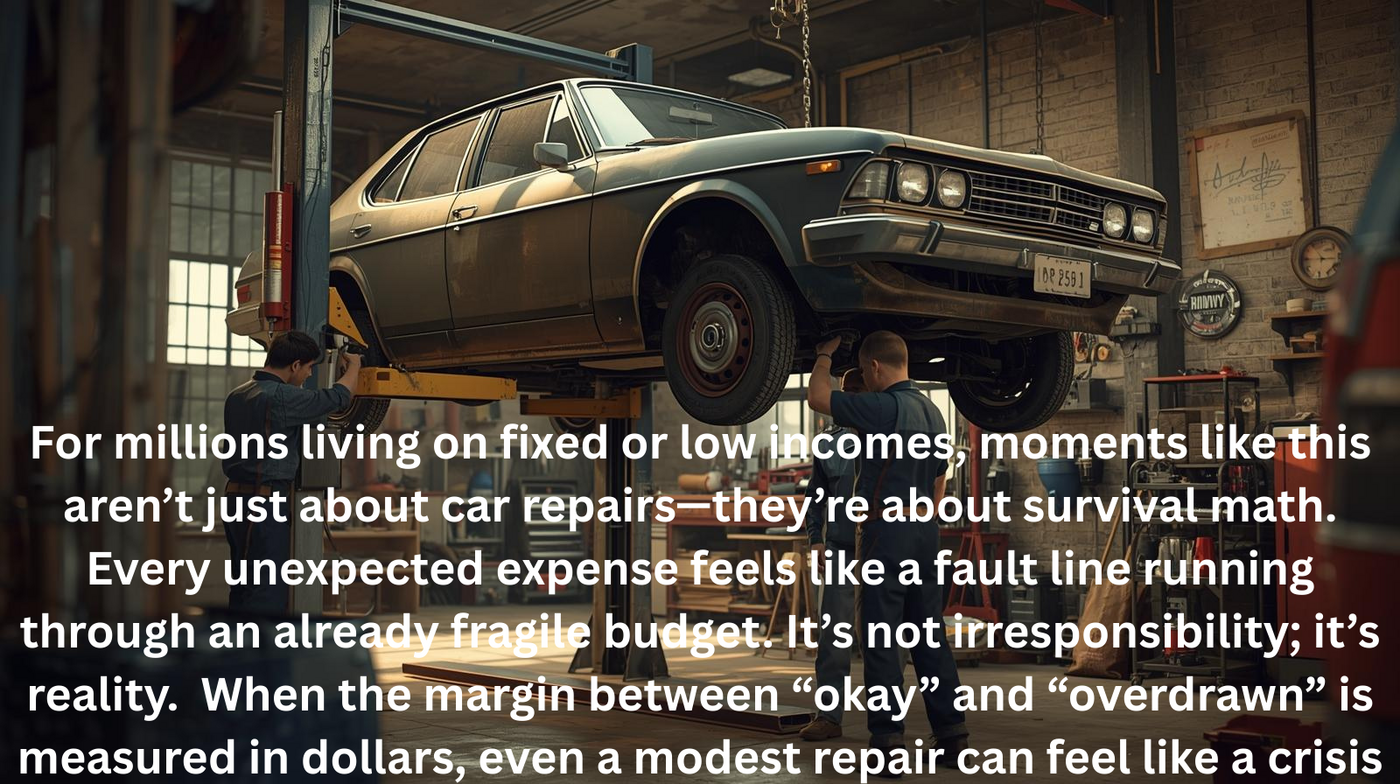
For millions living on fixed or low incomes, moments like this aren’t just about car repairs—they’re about survival math. Every unexpected expense feels like a fault line running through an already fragile budget. It’s not irresponsibility; it’s reality. When the margin between “okay” and “overdrawn” is measured in dollars, even a modest repair can feel like a crisis. Behind every statistic is a person weighing groceries against gas, safety against solvency, dignity against debt. If nothing else, let’s remember this: financial stress isn’t a character flaw—it’s a condition. And conditions can be changed if we choose to care enough to build systems that give people room to breathe.