Summary
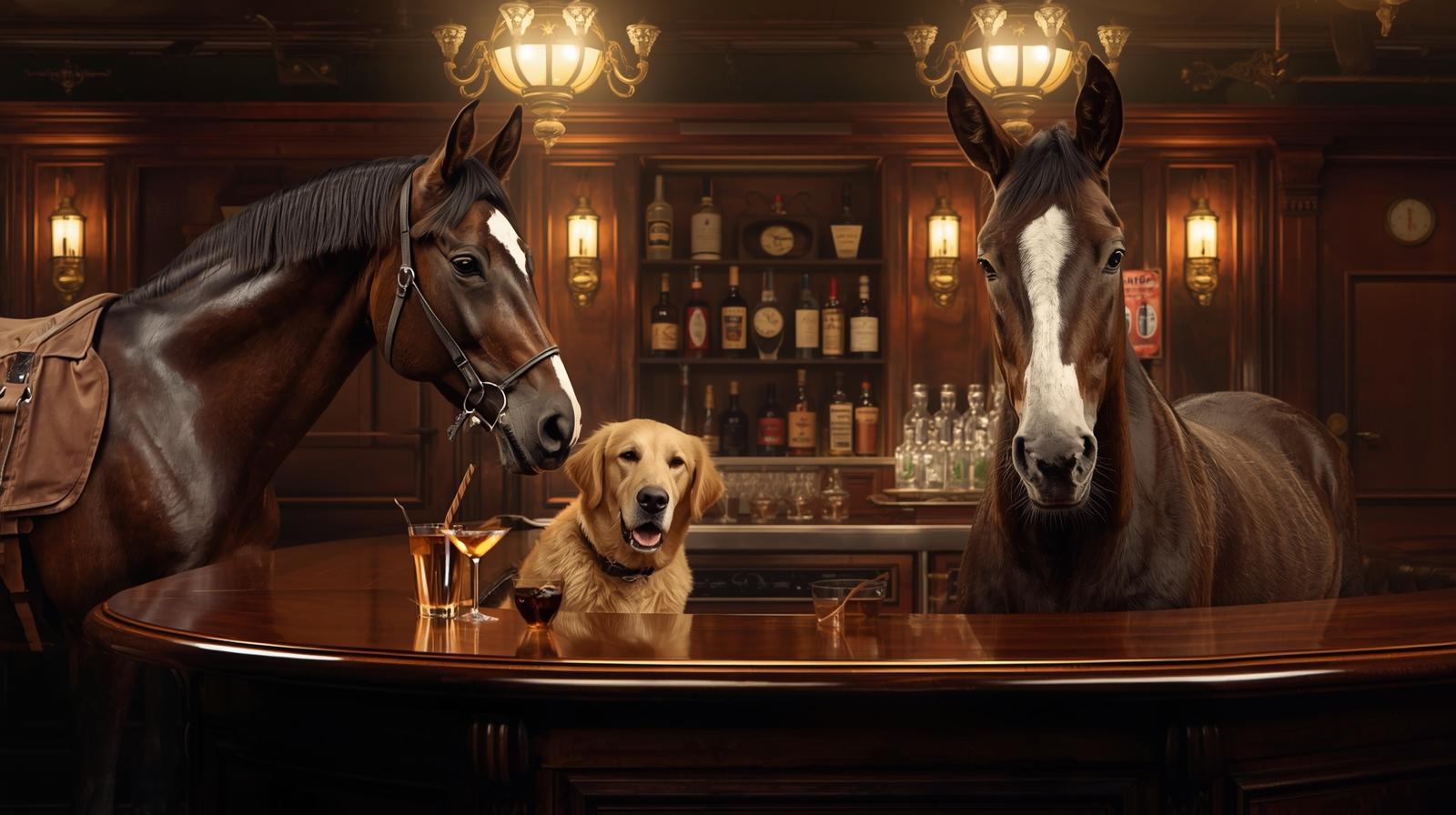
A horse, a dog, and a mule walked into a bar. After a couple of drinks, each declared that they were the smartest of the three.”
So, Which Is Smartest?
The honest answer is none—and all of them.
Dogs are unmatched in human-centered social intelligence. Horses excel in emotional awareness and contextual learning. Mules dominate problem-solving, memory, and risk assessment.
What we call “smart” often reflects what we value: obedience, cooperation, or independence. But intelligence isn’t about pleasing humans, but about surviving well.
And by that measure, each of these animals has mastered its own kind of brilliance.
Dogs, Horses, and Mules: Three Kinds of Intelligence, Three Kinds of Loyalty
Intelligence is not obedience; it is adaptation. Comparative cognition research shows that dogs, horses, and mules evolved to solve fundamentally different problems alongside humans, which explains why each species appears “smart” in different contexts.
Intelligence Is Not Obedience
Trainability is often mistaken for intelligence. In cognitive science, intelligence is better defined as problem-solving ability, memory retention, behavioral flexibility, and social cognition, all of which vary across species and evolutionary niches.
Dogs evolved for cooperative communication with humans, horses for social coordination and threat detection, and mules for risk assessment and survival efficiency.
1. Intelligence and Attention Span
Mules: Cognitive Strategy and Risk Assessment
Mules consistently outperform both horses and donkeys in visual discrimination learning and spatial problem-solving tasks, providing empirical evidence of hybrid vigor extending to cognition.
In controlled experiments, mules learned complex discrimination tasks faster and required fewer repetitions to reach criterion performance than either parent species. In detour-based spatial tests, mules also solved problems above chance on first exposure, unlike horses and donkeys.
What handlers often call “stubbornness” is more accurately described as deliberate risk evaluation—a trait widely documented in veterinary and behavioral research on donkeys and mules.
Mules do not refuse tasks randomly; they refuse tasks they perceive as unsafe.
Dogs: Communicative Intelligence and Human-Directed Attention
Dogs excel in social‑communicative intelligence, particularly in reading and responding to human cues. Multiple studies demonstrate that dogs engage in gaze alternation between humans and objects, a behavior associated with intentional communication and help‑seeking.
This behavior emerges early in puppies and is largely absent in wolves and great apes, highlighting the role of domestication in shaping canine cognition. Dogs also flexibly adjust their communicative behavior depending on whether a human partner is cooperative or knowledgeable.
Neuroscience research further shows inter-brain synchronization between dogs and humans during mutual gaze, suggesting joint attention and emotional coupling.
Horses: Contextual Intelligence and Emotional Sensitivity
Horses demonstrate strong long-term memory, emotional discrimination, and situational learning. Experimental studies show that horses can remember trained tasks and human handlers after months or even years of separation.
Research also confirms that horses recognize human faces and voices, matching them cross-modally—an advanced form of social cognition.
Their attention span varies with context: predictable environments foster sustained focus, while high‑arousal performance settings fragment attention—an adaptive trait for prey animals.
2. Ability to Form Human Relationships
Dogs: Attachment-Based Bonds
Dogs form attachment relationships with humans comparable to parent–child bonds, characterized by proximity seeking, separation distress, and safe-haven effects.
Oxytocin plays a central role in this bond. Positive human–dog interactions increase oxytocin levels in both species, reinforcing emotional attachment through a biological feedback loop.
Genetic studies further show that oxytocin receptor variants in both dogs and owners influence attachment strength, underscoring the bidirectional nature of the bond.
Horses: Trust-Based Social Partnerships
Horses form reciprocal relationships based on predictability, emotional regulation, and consistent handling. Studies show that positive reinforcement strengthens both task retention and affiliative behavior toward specific humans.
Unlike dogs, horses generalize trust more readily across humans, reflecting herd-based social cognition rather than individual attachment dependence.
Mules: Respect and Long-Term Loyalty
Veterinary and ethological research consistently notes that mules form strong, selective bonds with familiar humans but require more time and fairness to establish trust.
Once established, mule–human relationships are notably durable. Mules show heightened sensitivity to inconsistent handling and are less likely than horses to tolerate coercion, a behavior rooted in donkey evolutionary History.
3. Duration and Memory of Relationships
All three species possess exceptional long-term memory, but they prioritize different elements:
- Dogs retain sensory‑emotional associations (smell, voice, emotional safety) for years.
- Horses remember people, tasks, and locations for decades.
- Mules demonstrate lifelong memory for handlers and experiences, both positive and negative, consistent with risk-avoidant cognition.
Comparative Summary
|
Feature |
Dogs |
Horses |
Mules |
|
Short‑Term Memory |
Task-specific, minutes |
Days to weeks |
High spatial efficiency |
|
Long‑Term Memory |
Years (sensory/emotional) |
Decades (faces, voices, tasks) |
Lifelong (handlers, events) |
|
Bond Type |
Attachment‑based |
Mutual trust |
Respect-based Partnership's's |
Conclusion: Three Intelligences, Not One Winner
Scientific evidence does not support a single “smartest” species. Instead, dogs, horses, and mules represent three adaptive intelligences:
- Dogs excel at human-centered communication and emotional attachment
- Horses specialize in social awareness and contextual learning
- Mules dominate in problem-solving, memory, and risk assessment
Each is intelligent in the way survival requires.
References
Dog Cognition, Communication, and Attachment
1. Riemer, S., Bonorand, A., & Stolzlechner, L. (2024). Evidence for the communicative function of human-directed gazing in dog puppies. Animal Cognition, 27, Article 61. https://doi.org/10.1007/s10071-024-01898-y [
2. Heberlein, M. T. E., Oberliessen, L. V., Virányi, Z., Lutonsky, C., & Turner, D. C. (2025). Showing—intentional communication—in dogs (Canis familiaris). Frontiers in Psychology, 16. https://doi.org/10.3389/fpsyg.2025.1608797
3. Koyasu, H., Kikusui, T., Takagi, S., & Nagasawa, M. (2020). The gaze communications between dogs and humans: Recent research review. Frontiers in Psychology, 11, 613512. https://doi.org/10.3389/fpsyg.2020.613512 [
4. Kubinyi, E., Sommese, A., Gácsi, M., & Miklósi, Á. (2025). Dogs’ gazing behavior at humans and emotional comfort. Animals, 15(4), 483. https://doi.org/10.3390/ani15040483
5. Nagasawa, M., Mitsui, S., En, S., et al. (2015). Oxytocin‑gaze positive loop and the coevolution of human–dog bonds. Science, 348(6232), 333–336. https://doi.org/10.1126/science.1261022
6. Marshall‑Pescini, S., Schaebs, F. S., Gaugg, A., et al. (2019). The role of oxytocin in the dog–owner relationship. Animals, 9(10), 792. https://doi.org/10.3390/ani9100792
Horse Cognition, Memory, and Human Recognition
7. Sankey, C., Richard-Yris, M.‑A., Leroy, H., Henry, S., & Hausberger, M. (2010). Positive interactions lead to lasting positive memories in horses. Animal Behaviour, 79(4), 869–875.
8. Proops, L., McComb, K., & Reby, D. (2009). Cross-modal individual recognition in domestic horses. Proceedings of the National Academy of Sciences, 106(3), 947–951.
9. Henderson, A. J. Z. (2021). Hey, I remember you: The extraordinary equine memory. Horse Sport Magazine.
Mule and Donkey Cognition, Behavior, and Hybrid Vigor Proops, L., Burden, F., & Osthaus, B. (2009). Mule cognition: A case of hybrid vigour? Animal Cognition, 12(1), 75–84. https://doi.org/10.1007/s10071-008-0172-1
10. Osthaus, B., Proops, L., Hocking, I., & Burden, F. (2012). Spatial problem solving by horses, donkeys, and mules. ASAB Interdisciplinary Workshop on Physical Cognition.
11. McLean, A. K., Navas González, F. J., & Canisso, I. F. (2019). Donkey and mule behavior. Veterinary Clinics of North America: Equine Practice, 35(3), 575–588. https://doi.org/10.1016/j.cveq.2019.08.010
Comparative and Evolutionary Context
13. Goodwin, D. (2007). Equine learning behavior: What we know, what we don’t, and future research priorities. Behavioural Processes, 76(1), 17–19.
14. Miklósi, Á. (2015). Dog behaviour, evolution, and cognition (2nd ed.). Oxford University Press.