Summary
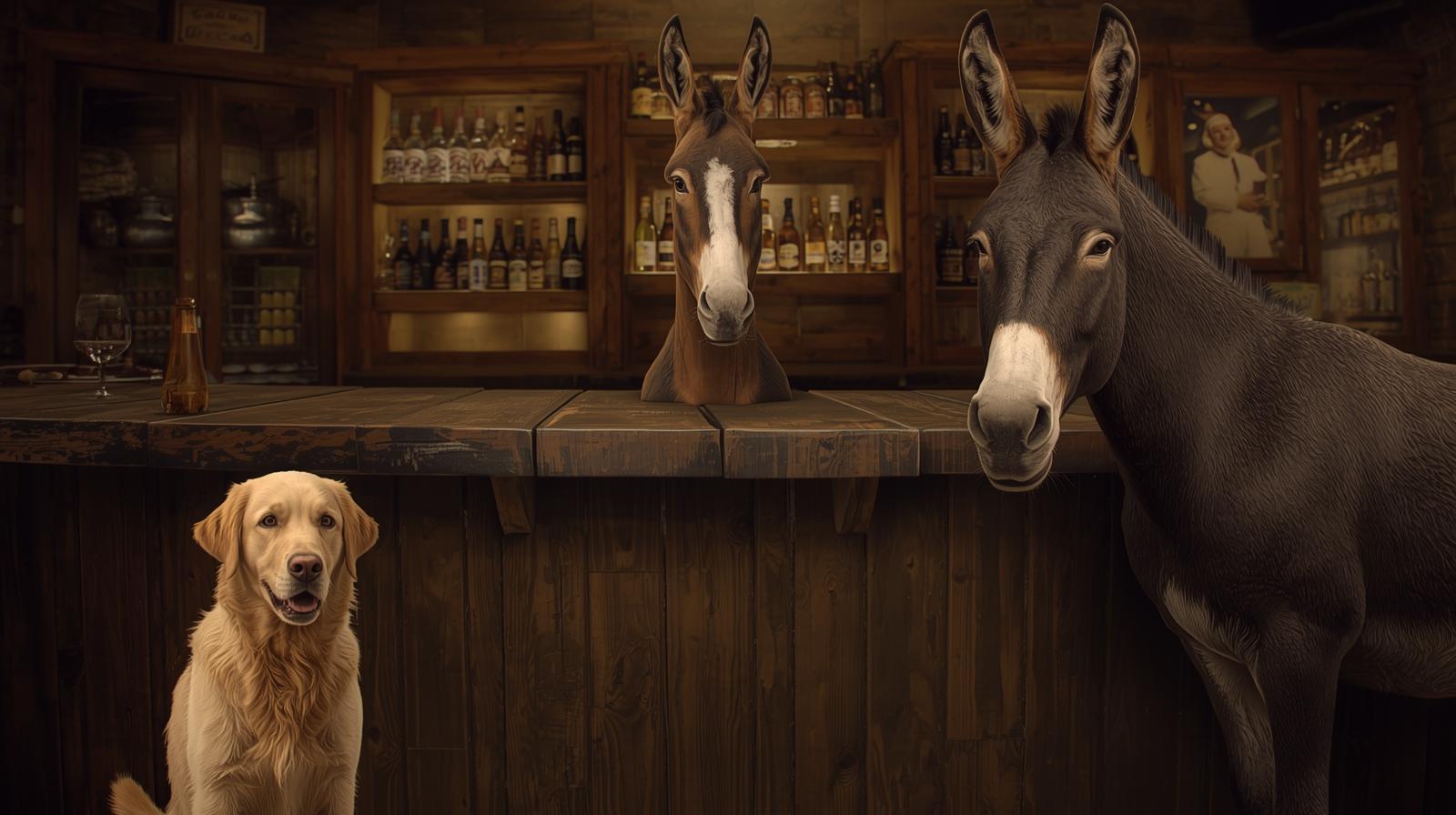
“A horse, a dog, and a mule walked into a bar. After a couple of drinks, each declared that they were the smartest of the three.”
Ask which animal is “smartest,” and you’ll get the wrong answer—because intelligence isn’t a single trait. Dogs, horses, and mules evolved to solve very different problems alongside humans. What appears to be obedience in one species may be caution in another, and what appears to be stubbornness may be advanced risk assessment.
To compare them fairly, we need to move beyond tricks and commands and examine attention span, relationship‑building, and the durability of those relationships over time. When viewed through that lens, dogs, horses, and mules reveal not a hierarchy of intelligence, but three distinct cognitive strategies shaped by evolution and work.
Intelligence Is Not Obedience
One of the most persistent myths in animal cognition is that the animal that complies fastest is the smartest. Intelligence manifests differently under different evolutionary pressures.
“If that were the case, my wife would really be dumb.”
Dogs evolved to cooperate closely with humans. Horses evolved to survive as prey animals within herds. Mules—hybrids of horses and donkeys—evolved under a different rule set entirely:
Don’t do something unnecessary. This sounds like they understand the 80/20 rule. Focus on the 20% that gets 80% of the results.
Each species excels in a different kind of thinking.
1. Intelligence and Attention Span
Mules: The Strategists
Among the three, mules consistently rank highest in problem‑solving and spatial reasoning. Their reputation for stubbornness is misleading; what handlers interpret as refusal is often risk calculation.
“Does that sound like someone that you live with?”
A mule’s attention span is selective but intense. If a task aligns with self-preservation and makes sense within the mule’s internal logic, it will focus longer and with greater precision than either a dog or a horse. If the task appears unsafe or pointless, the mule disengages—sometimes permanently.
This trait comes from hybrid vigor, combining the donkey’s cautious intelligence with the horse’s physical capacity. The result is an animal that remembers mistakes, avoids repeating dangerous situations, and prioritizes long-term survival over short-term compliance.
A mule isn’t untrainable, it’s unbribeable.
Dogs: The Communicators
Dogs excel in social and communicative intelligence, particularly with humans. Their attention span is uniquely tuned to human cues, including eye contact, gestures, tone of voice, and emotional expression.
“not like some people in my household.”
Unlike mules, dogs frequently alternate their gaze between a human and a task—behavior researchers interpret this as “asking for help.” Dogs are not just problem solvers; they are collaborative problem solvers.
Their attention span is strongest when a human is involved. Left alone with abstract tasks, dogs often disengage quickly. Introducing a person dramatically increases their focus.
This makes dogs exceptionally trainable—but also emotionally dependent.
“not like some people in my household””
Horses: The Contextual Thinkers
Horses sit between dogs and mules in terms of cognitive ability. They possess excellent long-term memory and high emotional sensitivity, but their attention span varies widely based on context and training.
A seasoned riding‑school horse often demonstrates longer, steadier attention than a high-performance competition horse, which may exhibit sharper but more fragmented focus. Horses evolved to continuously monitor their environment, scanning for threats while remaining socially attuned to the herd.
Their intelligence is situational, excelling in pattern recognition, routine tasks, and emotional feedback, rather than in abstract problem-solving.
2. Ability to Form Human Relationships
Dogs: Attachment-Driven Bonds
Dogs form the most intense and asymmetric relationships with humans. Their bonds often resemble parent-child dynamics, with humans serving as protectors, providers, and emotional anchors.
Dogs are evolutionarily predisposed to seek proximity, approval, and reassurance from people. This makes them deeply loyal—but also vulnerable to separation anxiety and emotional distress.
A dog doesn’t just remember who you are; it remembers how you made it feel safe.
Dogs don’t work with humans. They attach to them.
Horses: Trust-Based Partnerships
Horses form relationships built on mutual trust rather than dependency. They are highly sensitive to human emotional states, posture, and consistency. A calm, predictable human becomes a safe presence; an erratic one becomes a threat.
While horses may not seek constant proximity like dogs, they can form bonds just as emotionally significant. These relationships are reciprocal, grounded in clear communication and reliability.
Importantly, horses often generalize trust—positive handling by one person can improve their response to others, reflecting herd-based social cognition.
Mules: Respect Before Affection
Mules approach relationships transactionally, but not coldly. They require fairness, clarity, and time. A mule is far less tolerant of coercion or bullying than a horse and will test boundaries until mutual respect is established.
Bonding with a mule takes longer—but once formed, it is unusually deep and stable. Mules are known to single out trusted handlers and refuse cooperation with others, even when incentives are offered.
Their loyalty is not emotional dependence; it is earned Partnership's.
A mule doesn’t fall in love easily—but it never forgets who earned its trust.
3. Duration and Memory of Relationships
All three species possess remarkable long-term memory, capable of sustaining relationships across years or even decades.
Dogs recognize people through smell and sound long after visual memory fades. Horses can identify human voices and faces years after separation. Mules are legendary for remembering both kindness and mistreatment indefinitely.
The difference lies not in whether they remember, but in what they remember most vividly.
Comparative Memory and Bonding Overview
|
Feature |
Dogs |
Horses |
Mules |
|
Short‑Term Memory |
~2–4 minutes (task‑specific) |
Can recall routes after a week |
High, rapid spatial learning |
|
Long‑Term Memory |
Years or decades (sensory-based) |
Decades (faces, voices) |
Lifelong (handlers and events) |
|
Primary Bond Type |
Attachment / Dependence |
Social / Mutual trust |
Respect / Partnership's's's's's's's |
|
Response to Mistreatment |
Forgiving, anxiety-prone |
Avoidant, cautious |
Permanent loss of trust |