Summary
His pioneering spirit should inspire admiration in jazz enthusiasts, highlighting his transformative Impact on the genre.
Documentary of Hits
https://www.youtube.com/watch?v=vrJZ5ALNdV4
a) A Night in Tunisia
https://www.youtube.com/watch?v=mkemox0461U
b) Salt Peanuts
https://www.youtube.com/watch?v=gg1Wl-NmzWg
c) Groovin’ High
https://www.youtube.com/watch?v=K5yTYt-XqBA
d) Bebop
https://www.youtube.com/watch?v=C0wEX1tgyNw
e) Cubana Be
https://www.youtube.com/watch?v=dtCwaEK_TjA
f) King Porter Stomp
https://www.youtube.com/watch?v=EKIqvRgOkj8
g) Op Bop Sh’ Bam
https://www.youtube.com/watch?v=LSC0zze3dz0
h) Blue ‘in Boogie
https://www.youtube.com/watch?v=_C8n_gO72pQ
i) It’s My Way
https://www.youtube.com/watch?v=qRJnFJdIFbM
He came up through the hard way, not the soft way. After early professional work with Frankie Fairfax, Gillespie moved through bands led by Teddy Hill, Cab Calloway, Ella Fitzgerald, Earl Hines, Duke Ellington, and Billy Eckstine, sharpening his sound, his speed, and his harmonic nerve in the company of serious players. By the time the 1940s arrived, he was no sideman-in-waiting. He was a storm front.
Then came bebop, and with it the demolition of old musical furniture. Alongside Charlie Parker, Gillespie became one of the principal founders of the new language—faster, harder, smarter, and far less interested in pleasing people who wanted the band to stay safely in the background while they stirred their cocktails. Bebop was not dance music in the old sense. It was a declaration that jazz musicians were no longer content to be decorative employees in tuxedos.
And Gillespie was not just a virtuoso with fast fingers and a flashy upper register. He was also a serious composer and bandleader, writing pieces such as “Woody ’n’ You” and leading major ensembles that helped shape modern jazz. That matters, because plenty of players can blow hot for a few choruses; far fewer can build a movement, organize talent, and leave behind a musical structure sturdy enough to outlive the applause.
He also helped pioneer Afro-Cuban jazz, bringing Latin rhythms into the bloodstream of modern jazz and expanding the music’s rhythmic and harmonic range. That contribution alone would have secured his place in History because Gillespie was not content to master one innovation when he could help launch another. The man kept pushing, which is usually what separates a true original from a well-dressed imitator.
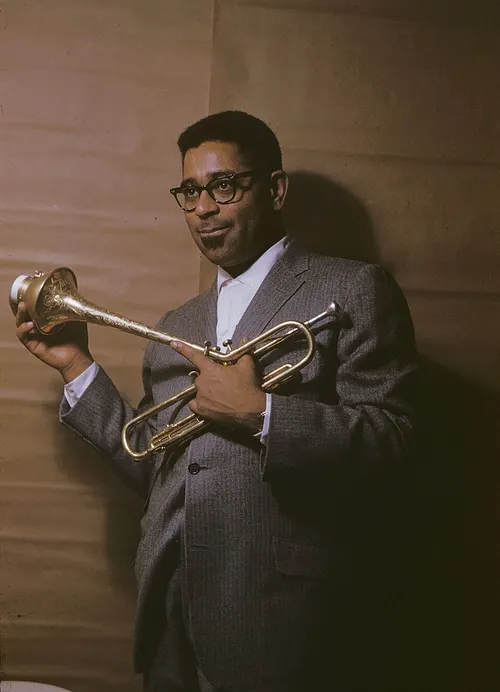
Of course, Dizzy understood something else that many “serious artists” never learn: showmanship matters. The bent trumpet, the puffed cheeks, the beret, the horn-rimmed glasses, the scat singing, the wit—none of it diminished the music. It amplified the message. Gillespie made genius look alive, human, playful, and dangerous all at once, inspiring readers to appreciate the power of personality in music.
And then there is the educator’s role, which is often where the real giants separate themselves from the merely brilliant. Gillespie influenced and taught generations of musicians, including major trumpeters who followed him. His legacy as a teacher should evoke pride in music students and inspire respect for his role in shaping future jazz talents.
So let’s say it plainly. Dizzy Gillespie did not just Play jazz. He helped re-engineer it. His innovative trumpet playing, harmonic genius, rhythmic fire, humor, nerve, and global influence set new standards in jazz. His legacy continues to inspire musicians and shape jazz’s future, making him a true architect of the music’s modern skyline. When he died in Englewood, New Jersey, on 6 January 1993, jazz did not lose a celebrity. It lost one of its chief architects, one of the few men with enough talent, daring, and personality to change the entire skyline of the music.