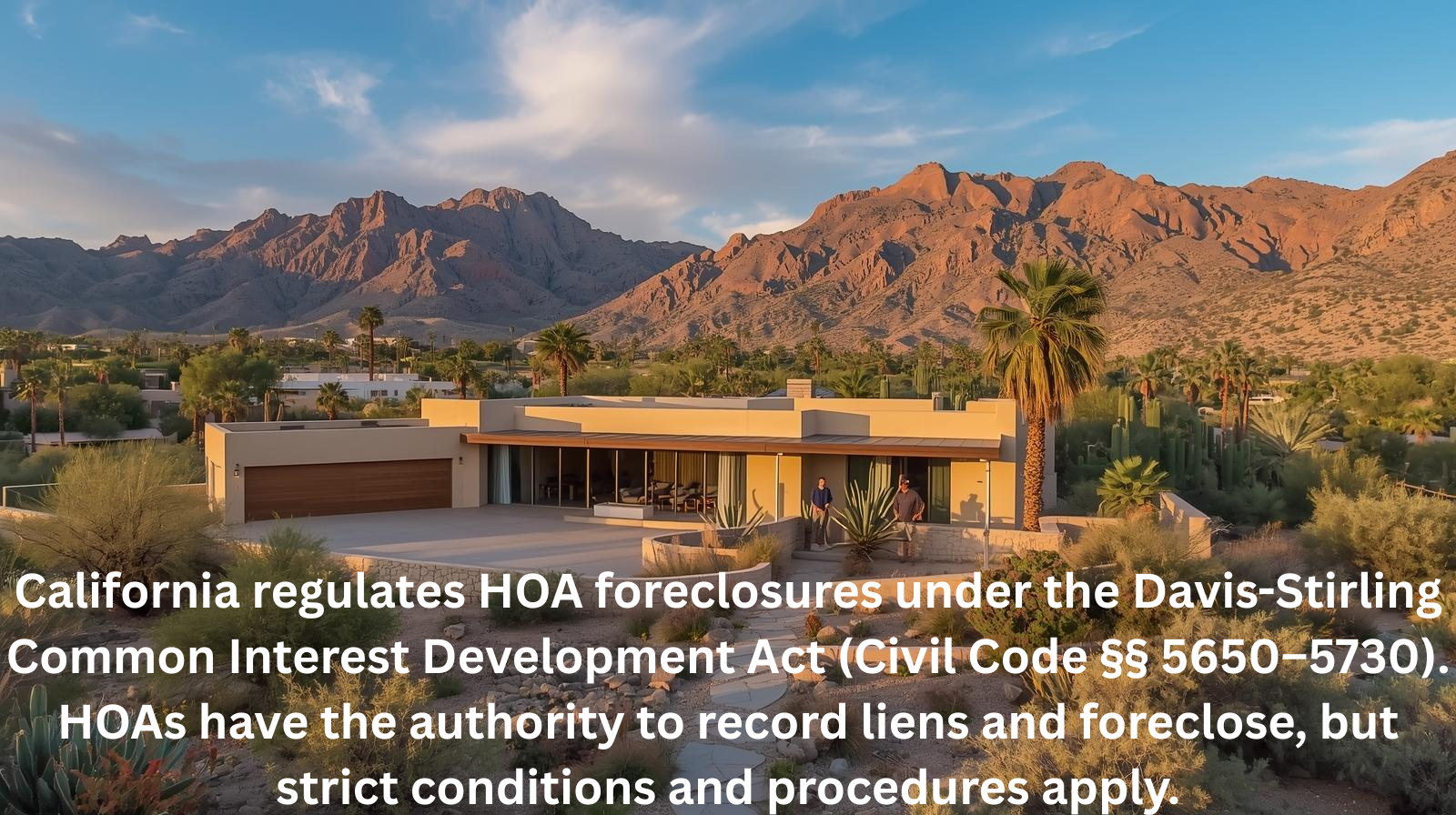
Threshold for Foreclosure
An HOA cannot foreclose unless:
- The homeowner owes $1,800 or more unpaid regular or special assessments (excluding late fees, fines, attorney’s fees, and collection costs), or
- The assessments have been delinquent for 12 months or longer.
(Civil Code §5720)
Step-by-Step Foreclosure Process
1. Pre-Lien Notice
- HOA must send a 30-day pre-lien notice via certified mail before recording a lien.
- Notice must include:
- Itemized debt (assessments, late charges, interest, collection costs)
- HOA’s collection policy
- Homeowner’s right to dispute the debt or request a payment plan
(Civil Code §5660)
2. Board Approval and Lien Recording
- HOA board must vote in an open meeting to approve the lien recording.
- The decision must be documented in meeting minutes.
- HOA records a Notice of Delinquent Assessment with the county recorder.
- A copy of the lien must be mailed to the homeowner within 10 days.
3. Waiting Period
- HOA must wait at least 30 days after recording the lien before initiating foreclosure.
4. Foreclosure Authorization
- HOA board must vote in an executive session to authorize foreclosure.
- Decision recorded in minutes of the following open meeting.
5. Foreclosure Method
- Nonjudicial foreclosure (most common):
- HOA records a Notice of Default and mails a copy to the homeowner.
- 90-day reinstatement period follows.
- After 90 days, the HOA records a Notice of Sale and schedules an auction.
- Judicial foreclosure: HOA files a lawsuit and obtains a court judgment authorizing sale.
6. Homeowner Protections
- Repayment Plan: HOA must offer a payment plan before foreclosure.
- Dispute Resolution: HOA must participate in Internal Dispute Resolution (IDR) if requested.
- Notice Requirements: Multiple notices required at each stage.
- Redemption Rights: Homeowner has a 90-day right of redemption after sale under Civil Code §2924m.
7. Lien Priority
- HOA liens are junior to first mortgages and earlier-recorded liens.
- California does not have super lien laws; first mortgages survive HOA foreclosure.
8. Super Lien Priority Statutes: California does not have a super lien statute for HOAs like some other states (e.g., Nevada, Colorado, Florida).
Under California Law:
- HOA liens are junior to first mortgages and deeds of trust. The priority of liens generally follows the “first in time, first in right” rule under Civil Code §2897, meaning earlier-recorded liens take precedence.
- California’s HOA lien priority is governed by Civil Code §5680, which states that an HOA lien for delinquent assessments is before all other liens recorded after the notice of delinquent assessment, except where the CC&Rs allow subordination. However, this does not override a first mortgage or deed of trust recorded before the HOA lien.
- The Davis-Stirling Act sets foreclosure rules: an HOA can foreclose only if the homeowner owes $1,800 or more in assessments or is 12 months delinquent, but the HOA foreclosure does not extinguish a senior mortgage lien.
Key Difference
Unlike super lien states, California does not grant HOAs priority over first mortgages for any portion of unpaid assessments. If an HOA forecloses, the buyer takes title subject to the first mortgage, and the Borrower remains personally liable for that mortgage debt.
California Civil Code §5680:
Text of Civil Code §5680
“A lien created pursuant to Section 5675 shall be before all other liens recorded after the notice of delinquent assessment, except that the declaration may provide for the subordination thereof to any other liens and encumbrances.”
(Added by Stats. 2012, Ch. 180, Sec. 2. Effective 1 January 2013; operative 1 January 2014) ,
What Does This Mean?
- Lien Creation: Under Section 5675, an HOA can record a lien for unpaid assessments after complying with the statutory notice requirements.
- Priority Rule: Once recorded, the HOA lien takes priority over any other liens recorded after the notice of delinquent assessment.
- Example: If the HOA records its lien today, and a judgment lien is recorded next week, the HOA lien is superior.
- Exception: The CC&Rs (Declaration) can allow subordination, meaning the HOA lien can be contractually placed behind other liens if the governing documents say so.
Do Junior Liens Get Wiped Out in California?
- Yes, most junior liens are extinguished when an HOA completes a foreclosure sale—except for senior liens, such as a first mortgage or deed of trust.
- California follows the “first in time, first in right” rule (Civil Code §2897). So:
- First mortgage recorded before the HOA lien survives the foreclosure.
- Junior liens (e.g., second mortgages, HELOCs, judgment liens, mechanic’s liens) recorded after the HOA lien are wiped out when the HOA forecloses.
Why?
- When the HOA records its Notice of Delinquent Assessment, the lien becomes senior to any liens recorded later (Civil Code § 5680).
- At foreclosure, the HOA sells the property subject to senior liens, but junior liens are eliminated because the foreclosure cuts off interests subordinate to the HOA lien.
Practical Example
- Timeline:
- First mortgage recorded in 2018
- HOA lien recorded in 2024
- HELOC recorded in 2025
- If HOA forecloses in 2026:
- First mortgage remains
- HELOC is wiped out
Key Caveats
- HOA foreclosure does not discharge the homeowner’s personal liability on wiped-out junior liens—they can still pursue the Borrower.
- The buyer at the HOA sale takes title subject to the first mortgage and any senior liens.
Buying at an HOA foreclosure auction in California involves risks that professionals and lenders should understand to make informed decisions and avoid surprises.
Here are the main risks:
9. Surviving Senior Liens
- HOA foreclosure does not wipe out first mortgages or other senior liens recorded before the HOA lien.
- The winning bidder takes title subject to the first deed of trust, which means:
- You may owe the entire mortgage balance if you want to keep the property.
- If you don’t pay, the lender will foreclose, and you could lose your investment.
10. Redemption Rights
- Under Civil Code §2924m, the 90-day right of redemption allows the former owner and certain lienholders to reclaim the property after sale, which can affect the timing of foreclosure and potential recovery options.
- If they redeem, you must return the property and will only get your bid amount back (plus interest), not any improvements or costs you incurred.
11. Unknown Property Condition
- HOA auctions are as-is sales:
- No inspections, disclosures, or warranties.
- Property may have deferred maintenance, code violations, or hidden damage.
12. Junior Liens and Personal Liability
- While most junior liens are wiped out, tax liens, IRS liens, and some municipal liens may survive.
- You must research the title carefully before bidding.
13. Occupancy Issues
- The former owner or tenants may occupy the property.
- Eviction can be costly and time-consuming.
14. Limited Title Insurance
- Many title insurers won’t issue a standard policy for HOA foreclosure purchases without exceptions.
- This increases the risk of undiscovered liens or title defects.
15. Cash Requirement
- HOA auctions typically require full payment in cash or cashier’s check immediately after the sale.
- No financing contingency.
Final Thoughts for Lenders
HOA foreclosure laws in California present unique risks for mortgage lenders. While first mortgages remain senior and survive HOA foreclosure, the process can still disrupt collateral value and create additional costs. If an HOA forecloses, the lender’s lien remains intact. Still, the property may be transferred to a third-party buyer who has no obligation to cure the mortgage, thereby increasing default risk. In some cases, lenders must advance funds to pay delinquent HOA assessments to protect their position. Proactive monitoring of Borrower HOA obligations, clear escrow procedures, and timely intervention are essential to mitigate exposure. Understanding lien priority and redemption rights isn’t optional—it’s a critical component of risk management in common-interest communities.
Lender Checklist for HOA Foreclosure Risk Management:
✅ Pre-Loan Due Diligence
- Verify HOA Status: Confirm the property is in a common-interest development and review CC&Rs.
- Check HOA Financial Health: Review HOA budgets, reserves, and delinquency rates.
- Confirm Assessment Amounts: Document monthly dues and any pending special assessments.
- Title Search: Ensure no existing HOA liens before closing.
✅ Ongoing Monitoring
- Track Borrower HOA Payments: Require proof of current HOA dues in escrow and periodically after closing.
- Monitor HOA Notices: Set alerts for recorded Notices of Delinquent Assessment or HOA foreclosure filings.
- Escrow HOA Dues (Optional): For high-risk borrowers, consider escrowing HOA payments.
✅ Intervention Steps
- Cure Delinquency Promptly: If Borrower defaults on HOA dues, pay the HOA to protect lien priority.
- Communicate with HOA: Establish contact for payoff amounts and foreclosure timelines.
- Evaluate Collateral Risk: If HOA foreclosure is imminent, assess the property’s value vs. the payoff cost.
✅ Foreclosure Response
- Bid at HOA Sale (Optional): Consider bidding to protect the collateral if the payoff is less than the property’s value.
- Prepare for Redemption Period: Understand California’s 90-day redemption rights under Civil Code §2924m.
- Secure Property Post-Sale: If the lender acquires property, address occupancy and title insurance issues.
✅ Documentation
- Keep records of all HOA communications, payoff requests, and lien releases for compliance and audit.
Practical Impact
- For Homeowners: If you’re delinquent, the HOA lien will outrank later-recorded liens, but your mortgage lender remains senior.
- For Lenders: First mortgages are protected; HOA foreclosure does not extinguish them.
- For HOAs: Recording the lien promptly is critical to establish priority over subsequent encumbrances.