Here are the key takeaways:
· Don’t Jump to Conclusions
Chicken Little’s assumption that the sky is falling after an acorn hits her head is a stark reminder of how acting on incomplete or misunderstood information can lead to unnecessary fear and dire consequences.
· Verify Before You Spread News
She spreads her fear to others without checking the facts, causing widespread panic. The story warns against spreading rumors or unverified claims.
· Critical Thinking Matters
Unthinkingly following others without questioning can lead to disastrous outcomes. The other animals follow Chicken Little without thinking, which ultimately leads them into danger. This underscores the importance of critical thinking in making informed decisions.
· Fear Can Be Manipulated
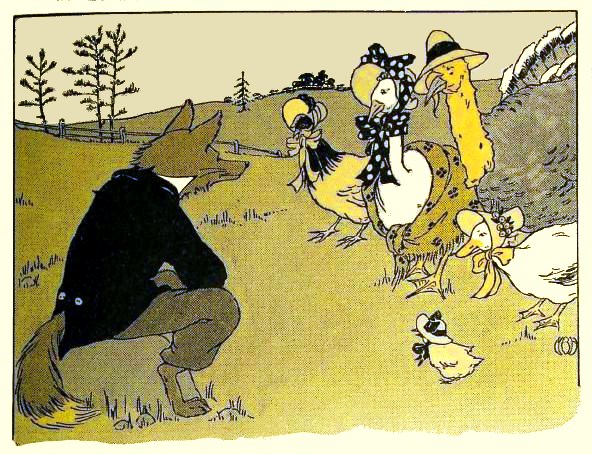
In many versions, the fox exploits the animals’ panic to lure them into harm. This illustrates how fear can make people vulnerable to manipulation. It also underscores the need to manage fear wisely to avoid falling prey to such tactics.
In short: Think before you act, confirm facts before sharing, and don’t let fear cloud your judgment.
Chicken Little and the Risk-Free Business Plan
Chicken Little had always been cautious. After all, the sky once fell—or so she thought—and that experience taught her one thing: never take chances.
When the barnyard animals started talking about opening a new grain-trading business, Chicken Little was invited to join. “It’s booming!” said Goosey Lucy. “High demand, low supply. We’ll make a fortune!” The animals were excited about the potential profits from the grain-trading business, but Chicken Little’s experience with the falling sky made her cautious.
But Chicken Little shook her head.
“What if the market crashes? What if the grain spoils? What if the sky falls again?”
Instead of investing, she decided to keep his savings buried under the old oak tree. She even wrote a 47-page risk analysis report titled ‘Why Everything Could Go Wrong.’
Months passed. The grain business thrived. Goosey Lucy and Henny Penny expanded into organic feed and delivery drones. Even Turkey Lurkey bought a shiny new tractor.
Meanwhile, Chicken Little sat on his pile of coins, watching inflation nibble away at his nest egg. She felt safe—but stagnant. Her friends weren’t reckless; they managed risks smartly. They diversified, insured their assets, and adapted when storms came.
Leadership Lessons from Chicken Little: Why Playing It Too Safe Can Cost You Big
“The sky is falling!” is a perfect metaphor for how fear can hijack leadership judgment. Below, each lesson includes a quote and practical examples that show how great leaders turn uncertainty into progress.
Lesson 1: Verify Before You Amplify
Quote (Howard Schultz):
“There are moments in our lives when we summon the courage to make choices that go against reason… we lean forward, nonetheless… despite all risks.”
Example—Starbucks in 2008:
When conventional wisdom said, “cut and freeze,” Howard Schultz audited reality—store economics, brand health, and consumer behavior—then chose targeted closures, barista retraining, and tech investment (e.g., digital infrastructure), rather than blanket austerity. That verification-driven approach helped the brand exit the crisis stronger.
Example—Bezos’ “disagree and commit”:
Jeff Bezos institutionalized mechanisms to test assumptions (experiments, “two-way door” decisions) and move forward even amid disagreement, emphasizing long-term thinking over rumor-driven short-termism.
Actionable takeaway: Before broadcasting a threat or pivot, triangulate with data, customer signals, and experiments—then communicate the verified picture, not the first impression.
Lesson 2: Fear Is Contagious—Manage It Wisely
Quote (Jeff Bezos):
“Complaining is not a strategy. You have to work with the world as you find it.”
Example—Amazon’s long-term calm:
Amid early skepticism about e-commerce economics, Bezos reiterated the strategy—customer obsession and long-term reinvestment—and avoided fear-messaging that would spook teams. That clarity sustained bold bets (Prime, logistics, AWS) through volatile cycles.
Example—Schultz’s tone in crisis:
Schultz combined candor about pain with a forward posture—“instill confidence in others when you yourself are feeling insecure”—a communication style that arrests panic and channels energy into action.
Actionable takeaway: In downturns, acknowledge reality, set a stabilizing cadence, and over-index on clarity (priorities, runway, decision criteria). Fear fills a vacuum; remove the vacuum.
Lesson 3: Risk Aversion Can Be Risky
Quote (Richard Branson):
“You can’t run a business without taking risks. The brave may not live forever—but the cautious do not live at all!”
Example—Spanx’s founder bet on herself:
With $5,000 in savings and no fashion background, Sara Blakely launched Spanx after repeated rejections—an archetype of calculated personal risk that became a billion-dollar brand.
Example—Starbucks advancing into headwinds:
Rather than maximizing short-term safety in 2008, Schultz advanced strategically in tech and store experience—illustrating how moving toward a vision can be safer than defensive stasis.
Actionable takeaway: Define a risk budget (the amount of risk you can afford to take), a thesis (why it’s worth taking the risk), and kill criteria (when you’ll stop taking the risk). Then move forward with your decision—or accept the opportunity cost of not taking the risk.
Lesson 4: Critical Thinking Beats Blind Following
Quote (Satya Nadella):
“The learn‑‑will always do better than the know‑‑.”
Example—Microsoft’s cloud pivot:
Nadella questioned software-licensing orthodoxy and reframed Microsoft around cloud and open source, coupling a mindset (“growth” vs “fixed”) with structural changes—an outcome of inquiry over inertia.
Example—Netflix’s “freedom & responsibility”:
Reed Hastings built a culture where challenging assumptions is expected (“farming for dissent,” radical candor). If people don’t voice dissent, it’s considered disloyal to the mission.
Actionable takeaway: Normalize devil’s advocates, pre‑mortems, and “red teams.” Reward those who surface dissenting evidence early.
Lesson 5: Beware of Manipulators
Quote (Indra Nooyi):
“The challenge of a leader is looking around the corner—and making the change before it’s too late to make the change.”
Example—PepsiCo’s health pivot:
Nooyi anticipated long-term consumer health trends and rebalanced the portfolio toward better-for-you products, despite pressure to chase near-term sugar economics, thereby reducing vulnerability to external rhetoric and regulatory shocks.
Example—Crisis opportunists:
In chaotic markets, counterparties can press for predatory terms. Leaders who model scenarios, secure optionality, and signal strength (walk-away readiness) reduce exploitable fear. (See risk-taking CEO profiles and contrarian plays during downturns.)
Actionable takeaway: Map who benefits if your team panics. Build early‑warning indicators and “if‑then” playbooks so you’re never negotiating from fear.
Lesson 6: Communication Shapes Outcomes
Quote (Sara Blakely):
“Failure is not the outcome—failure is not trying. Don’t be afraid to fail.”
Example—Netflix’s candor in practice:
Hastings codified a culture where direct, honest feedback is the norm (e.g., calling out counterproductive communication in the room so the meeting can recover). That metacommunication prevents spirals of confusion or panic.
Example—Schultz on authenticity:
Schultz argued that enduring brands are built “from the heart,” and that transparency is the “currency of leadership,” aligning tone with truth to maintain trust during hard calls.
Actionable takeaway: Train leaders to name emotion, state the fact, and frame the path. Use consistent phrases (“Here’s what we know/don’t know / what we’re doing next”) to immunize the org against rumor.
Lesson 7: Adaptability Is Key
Quote (Reed Hastings):
“Companies rarely die from moving too fast, and they frequently die from moving too slowly.”
Example—Netflix’s pivot to streaming:
Netflix shifted from DVDs to streaming before infrastructure fully supported it—then doubled down on originals. That willingness to change the model early (and often) is the hallmark of adaptability.
Example—Microsoft culture refresh:
Nadella’s mantra—create clarity, generate energy, deliver results—paired with risk-tolerant learning (failure as a learning opportunity) helped a massive incumbent reinvent at speed.
Actionable takeaway: Treat strategy as living code. Schedule cadenced reviews to retire what no longer works and green-light experiments that could obsolete your own model.
Bottom Line
The fable’s warning isn’t about ignoring danger—it’s about refusing to be ruled by it. The leaders above show how to verify, communicate, and act—even when the acorns are falling.
Closing Paragraph:
The Chicken Little mindset is alive and well in boardrooms today—manifesting as fear-driven decisions, endless risk avoidance, and paralysis in the face of uncertainty. But leadership isn’t about hiding from falling acorns; it’s about distinguishing real threats from imagined ones and acting with courage and clarity. The leaders who thrive aren’t those who eliminate risk—they’re the ones who replace anxiety with evidence, fear with foresight, and hesitation with bold, informed action.