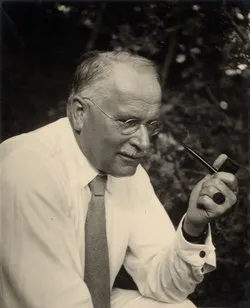
Most people use Jungian ideas every day without realizing it. When we talk about being an “introvert,” wrestling with our “shadow,” or searching for purpose later in life, we are standing on the intellectual foundation of Carl Jung.
More than a psychiatrist, Jung was a cartographer of the inner world—mapping the patterns that quietly shape human behavior across cultures and generations.
Who Was Carl Jung?
Carl Gustav Jung (1875–1961) was a Swiss psychiatrist and the founder of analytical psychology, a school of thought that broke decisively from Freud’s psychoanalysis.
While Sigmund Freud emphasized sexuality and repression, Jung expanded psychology’s scope to include mythology, religion, symbols, and the shared structures of the human psyche.
Jung trained at the University of Basel and the University of Zurich, later working at the Burghölzli Psychiatric Hospital under Eugen Bleuler. His early collaboration with Sigmund Freud positioned him as Freud’s intellectual heir—until their theoretical differences became irreconcilable.
By 1913, Jung went his own way, developing ideas that would influence psychology, literature, theology, and popular culture for more than a century.
The Collective Unconscious: Jung’s Most Radical Idea
Jung’s most enduring contribution is the concept of the collective unconscious—a deep layer of the mind shared by all humans that contains inherited patterns of meaning rather than personal memories.
“We are not born as blank slates; we inherit psychological structures just as surely as we inherit our anatomy.”
Within the collective unconscious live archetypes—universal symbols such as the Hero, Mother, Shadow, and Wise Old Man. These archetypes surface in myths, dreams, religious stories, and modern films, shaping how people interpret experience across cultures. Jung argued that these patterns explain why similar stories appear in societies that have never interacted.
Archetypes and the Inner Cast of Characters
Archetypes are not stereotypes; they are psychological blueprints. Jung identified several that Play recurring roles in personal development:
- The Persona: the social mask we present to the world
- The shadow: the rejected or hidden aspects of the Self
- Anima / Animus: the inner feminine and masculine dimensions of the psyche
- The Self: the integrating center of the personality
These forces operate whether we acknowledge them or not. Jung believed psychological health requires confronting—rather than suppressing—the Shadow and integrating opposing forces within the psyche.
“What you resist, persists. What you integrate, transforms.”
Introversion, Extraversion, and Personality Types
Jung also introduced the concepts of introversion and extraversion, describing how individuals orient their energy inward or outward. Unlike modern personality labels, Jung treated these as tendencies rather than fixed identities.
His theory of psychological types later became the foundation for the Myers-Briggs Type Indicator (MBTI)—one of the most widely used personality frameworks in business, education, and leadership training. While Jung himself warned against rigid typologies, his work permanently changed how people think about personality differences.
Individuation: The Lifelong Task of Becoming Whole
At the heart of Jung’s psychology is individuation—the lifelong process of becoming a whole, integrated person. Unlike self-improvement models focused on optimization or success, individuation emphasizes meaning, balance, and inner coherence. [
Jung observed that many people function well in the first half of life by adapting to society—building careers, families, and status. The second half, however, demands inward development: reconciling unrealized parts of the Self and confronting existential questions of purpose and mortality.
“Midlife is not a crisis—it is a summons.”
Dreams, Symbols, and the Language of the Unconscious
Jung treated dreams as meaningful communications rather than random mental noise. He believed dreams use symbolic language to compensate for conscious blind spots, offering guidance toward psychological balance. Dream analysis, mythological study, and symbolic interpretation became core tools of Jungian therapy.
Unlike Freud, Jung did not insist on universal interpretations. A symbol’s meaning, he argued, depends on both universal archetypes and the individual’s life context—a nuance that continues to influence modern psychotherapy.
Criticism and Controversy
Jung’s ideas have not escaped criticism. Some scholars argue that his theories lack empirical rigor and rely too heavily on symbolism and subjective interpretation. Others point to controversial aspects of his personal life and political judgments during the early 20th century.
Yet even critics concede that Jung’s influence extends far beyond clinical psychology. His ideas reshaped how Western culture understands myth, religion, creativity, and personal meaning.
Why Jung Still Matters
Jung matters because modern life is rich in information but poor in meaning. His work speaks directly to people navigating identity, disillusionment, and spiritual hunger in a secular age.