Summary
That fantastic deal that got you to click, call, or drive across town—only to “mysteriously” disappear when you arrived? That’s often bait and switch: a tactic designed to pull you in with one offer and steer you to something else (usually pricier). It’s not just annoying, it’s a classic form of deceptive marketing.
What “Bait and Switch” Means
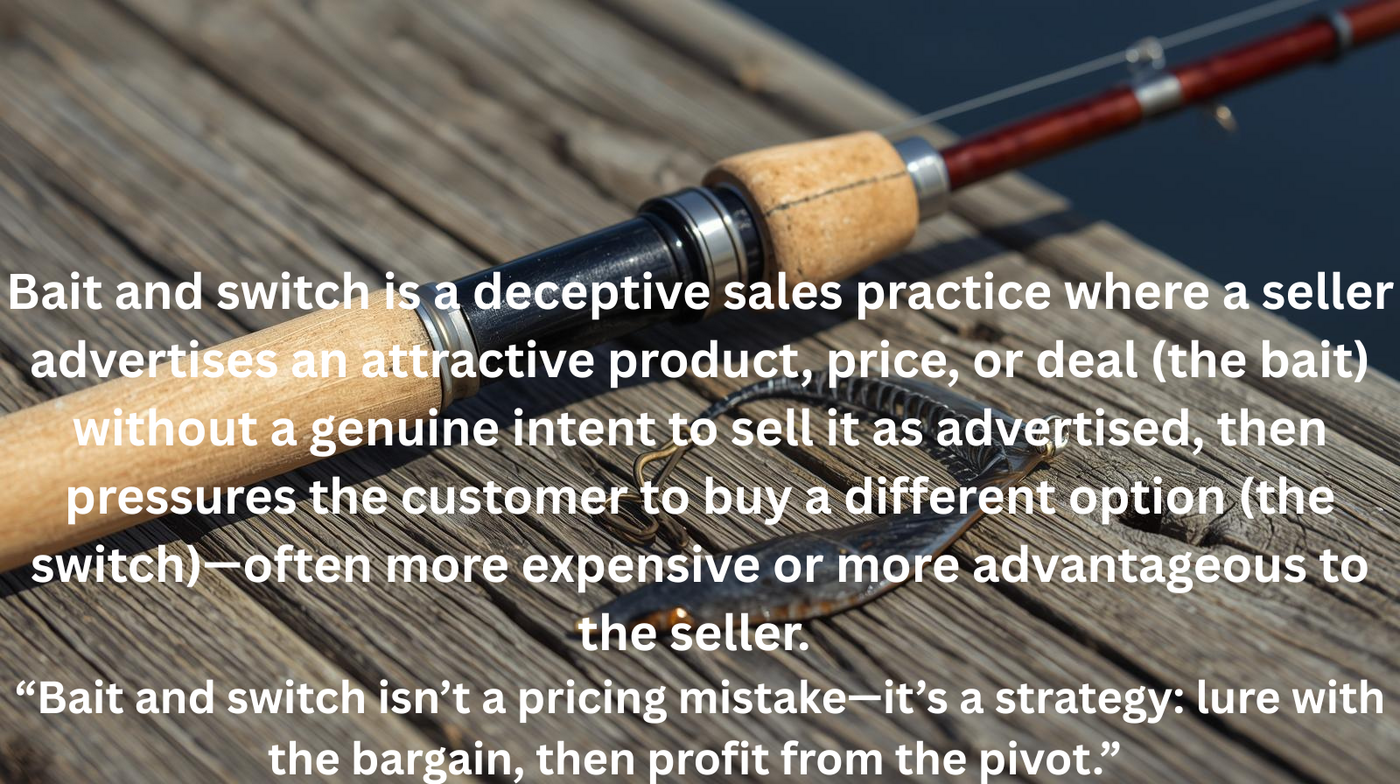
Bait and switch is a deceptive sales practice where a seller advertises an attractive product, price, or deal (the bait) without a genuine intent to sell it as advertised, then pressures the customer to buy a different option (the switch)—often more expensive or more advantageous to the seller.
Takeaway:
“Bait and switch isn’t a pricing mistake—it’s a strategy: lure with the bargain, then profit from the pivot.”
Where the Phrase Comes From
The phrase borrows from fishing and hunting imagery: “bait” draws you in, and “switch” redirects you once you’re committed (time, attention, momentum). The term appears in print by the early 1960s; Merriam-Webster lists 1962 as its first known use in this sense.
How the FTC Defines the Core Idea
U.S. consumer-protection guidance describes “bait advertising” as an alluring but insincere offer that the advertiser does not intend to fulfill, used to switch consumers to different merchandise—typically at a higher price or on terms better for the seller.
Two important clarifiers from the FTC guidance:
- Even if the “truth” comes out later, the deception can still be illegal if misleading impressions were created to secure the initial contact.
- Selling some of the advertised items doesn’t automatically “prove” it was legit; token availability can be used to create an “aura of legitimacy.”
You can reduce the risk of a bait-and-switch by verifying product availability online before visiting, checking reviews, and asking sales staff directly about stock and pricing.
You’ll usually see a predictable pattern:
The Bait
- A headline price that feels irresistible
- A “limited time” promise with unclear details
- A specific model/service featured prominently
The Block
Once you bite:
- “We’re out of stock” (sometimes implausibly fast)
- “That model is terrible. Let me show you the good one.”
- “That price was only with add-ons/fees/requirements.”
The Switch
- A higher-priced alternative
- Worse terms (fees, financing, contract length)
- A different product class entirely
Example line:
“The bait gets you in the door. The switch is where they make their money.”
Bait and switch vs. “Loss Leader” (Important Difference)
Not every cheaply advertised deal is a bait-and-switch.
A loss leader (legitimate) is when a seller offers a limited number of discounted items and clearly discloses limits (quantity, time, conditions). A bait-and-switch occurs when the seller never made a bona fide effort to sell the advertised deal and instead aimed to divert you to something else.
Facts:
- Loss leader: genuine offer + clear limits disclosed. Costco’ss giant $1.50 hotdog)
- Bait-and-switch: an insincere offer followed by pressure to buy something else.
“If the deal disappears the moment you ask for it, you weren’t shopping-you were being steered.” This helps the audience feel empowered to spot and avoid deceptive practices, boosting their confidence in protecting themselves.
Look for these warning signs:
- Vague availability (“while supplies last” with no real stock plan)
- No rain checks / won’t take orders for later delivery (or refuses reasonable delivery)
- Sales staff discourages the advertised product—won’t show it, disparages it, or makes it seem impractical.
- Implausibly low inventory for the size of the promotion (not “reasonably anticipated demand”)
- Compensation or scripts that steer away from the advertised item
One-liner:
“If the deal disappears the moment you ask for it, you weren’t shopping—you were being steered.”
Is Bait and Switch Illegal?
In many cases, bait-and-switch is illegal because it constitutes deceptive advertising. If you suspect this practice, you can file a complaint with agencies like the FTC or your state consumer protection office, which can investigate and take action against violators. Knowing your rights encourages proactive responses.
Also, legal authorities commonly characterize bait-and-switch as potentially supporting claims of fraud or related consumer-protection actions (depending on the facts and jurisdiction).
(Quick note: I’m not a lawyer—this is general information, not legal advice.)
What to Do If You Encounter It
In the moment:
- Ask to see the advertised product (not just hear about it).
- Request a rain check or order option at the advertised terms.
- Write down names, dates, and exact statements (who said “out of stock,” what alternative was pushed).
Afterward:
- Save the ad/screenshot, product link, and receipts.
- Consider filing a consumer complaint with the appropriate agency (e.g., the FTC or a state agency).
Reminder:
“Screenshots are the modern consumer’s seatbelt—take them before the story changes.”
For Businesses: How to Avoid Accidental “Bait and Switch” Optics
Even honest sellers can look deceptive if execution is sloppy.
To stay clean:
- Stock enough inventory for reasonably anticipated demand, or clearly disclose limits up front.
- Train staff to sell the advertised item in good faith—no scripted disparagement.
- Offer rain checks/orders when feasible and reasonable.
Conclusion
Bait and switch works because it exploits momentum: once you’ve invested time and attention, you’re more likely to “just pick something” and move on. But the core test is simple—was the advertised offer a bona fide attempt to sell, or merely a lure to redirect you?
“A fair deal can be limited. A bait-and-switch deal is designed to vanish.”