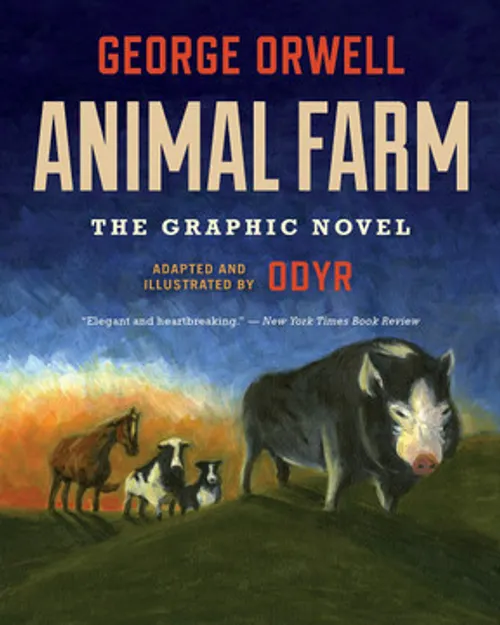
The story begins with animals overthrowing their human farmer, hoping to create an equal society. They establish the principle that “All animals are equal.” However, over time, the pigs—who assume leadership—become corrupt, manipulate language, and consolidate power. This gradual transformation leads to a stark betrayal of the revolutionary ideals, a moment of disillusionment that the animals and the readers alike experience.
https://en.wikipedia.org/wiki/Animal_Farm
Core Meaning and Themes
- Corruption of Power
Orwell illustrates how revolutions often start with noble intentions but can devolve into tyranny when leaders prioritize power over principles. - Manipulation Through Language
The pigs use propaganda and revise commandments to control the other animals, showing how language can distort truth and maintain authoritarian control. - Class Stratification and Inequality
Despite promises of equality, a new elite emerges. This reflects Orwell’s critique of how socialist ideals were corrupted in practice. - Warning Against Totalitarianism
The book is a stark cautionary tale about how unchecked authority and lack of accountability lead to oppression. It serves as a powerful warning, urging us to remain vigilant and transparent to prevent such tyranny.
Famous Closing Line:
“All animals are equal, but some animals are more equal than others.”
This encapsulates the regime’s hypocrisy and moral decay.
The pigs in Animal Farm are the most significant symbols in the book.
Here’s what they represent and why:
Symbolism of the Pigs
- Political Leaders and the Corruption of Power
The pigs, representing the ruling class, initially champion equality but gradually become authoritarian, mirroring the very oppression they sought to overthrow. This transformation is a stark warning that revolutionary leaders often become indistinguishable from the oppressors they replaced. - Intellectual Elite and Manipulation
Pigs are portrayed as the most intelligent animals, which allows them to assume leadership. Orwell uses this to show how those with knowledge can manipulate others through propaganda and information control. - Transformation into Tyrants
As the story progresses, the pigs adopt more human behaviors—walking on two legs, wearing clothes, and dining with humans. This symbolizes a dangerous transformation, a warning sign that revolutionary leaders often become indistinguishable from the oppressors they replaced. - Hypocrisy of Ideals
The pigs rewrite the commandments, culminating in the infamous line:
“All animals are equal, but some animals are more equal than others.”
This stark betrayal of socialist ideals and the emergence of a privileged elite prompt us to examine the realities of power and equality critically.
In short: The pigs embody Orwell’s warning that power tends to corrupt, and unchecked authority—even under the banner of equality—can lead to tyranny.
The pigs in Animal Farm masterfully manipulate language as a tool of control and propaganda. This is a stark illustration of how those in power can distort truth to maintain their authority.
Here’s how they do it:
1. Slogans and Simplification
They reduce complex ideas into catchy phrases like “Four legs good, two legs bad.” This oversimplification discourages critical thinking and creates unquestioning loyalty.
2. Gradual Revision of Rules
The pigs alter the Seven Commandments over time, but they do it subtly:
- Original: “No animal shall sleep in a bed.”
- Revised: “No animal shall sleep in a bed with sheets.” This incremental change makes violations seem acceptable and normalizes Corruption.
3. Euphemisms and Reframing
They use soft language to mask harsh realities:
- “Readjustment of rations” instead of “food shortage.”
- “Voluntary work” that is actually mandatory.
4. Propaganda Through Fear
Squealer, the propaganda pig, constantly warns that Jones might return if the animals question leadership. Fear becomes a linguistic weapon to suppress dissent.
5. Twisting Logic
They claim pigs need more privileges because they “work with their brains,” framing exploitation as a necessity for the common good.
6. Final Commandment ultimate distortion:
“All animals are equal, but some animals are more equal than others.”
This paradoxical phrase shows how language can be twisted to justify inequality.
Meaning: Orwell demonstrates that language isn’t just communication—it’s power. When leaders control words, they control reality.
Closing Paragraph:
Animal Farm is more than a story about animals—it’s a timeless warning about the fragility of ideals when power goes unchecked. Orwell shows how revolutions can begin with promises of equality yet end in tyranny when leaders manipulate truth and language to serve themselves. The book’s enduring lesson is clear: vigilance, transparency, and accountability are essential to prevent Corruption—whether in governments, corporations, or communities. Without them, “all animals are equal” becomes nothing more than a slogan, and History repeats itself.